

ERP vs CRM: Which Business Software Is Right for You?
Introduction
As businesses grow, managing day-to-day operations becomes increasingly complex. Sales teams need to track leads and customer interactions, finance departments must monitor budgets and invoices, inventory requires accurate management, and leadership needs real-time insights to make informed decisions.
Many organizations reach a stage where spreadsheets, disconnected software, and manual processes are no longer enough. This is where business management systems like Enterprise Resource Planning (ERP) and Customer Relationship Management (CRM) come into the picture.
One of the most common questions business owners ask is: ERP vs CRM—which solution is right for my business?
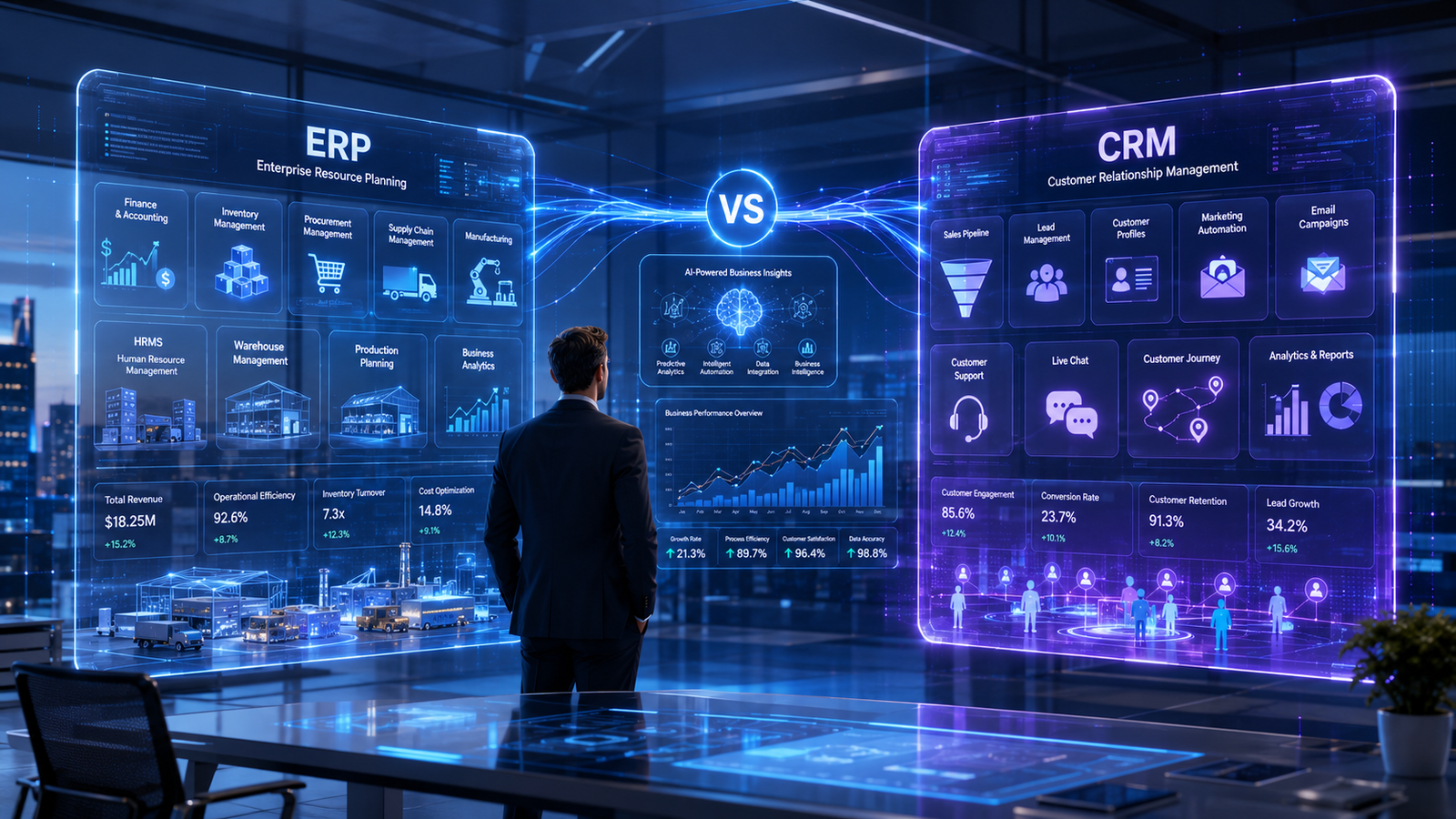
Although both systems improve efficiency and support business growth, they are designed for different purposes. An ERP system focuses on managing internal business operations such as finance, inventory, procurement, manufacturing, and human resources. A CRM system, on the other hand, is designed to strengthen customer relationships by managing sales, marketing, customer service, and communication.
Choosing the right solution can significantly improve productivity, reduce operational costs, and support long-term business growth. However, selecting the wrong system may result in unnecessary expenses and limited business value.
In this guide, we'll explore the differences between ERP vs CRM, explain how each system works, compare their features, and help you determine which solution best aligns with your business goals.
Understanding Business Management Software
Modern businesses generate large amounts of information every day—from customer inquiries and sales orders to inventory records and financial transactions.
Without an integrated system, this information often becomes scattered across different departments, making collaboration difficult and reducing overall efficiency.
Business management software helps organizations centralize information, automate repetitive tasks, and improve communication between teams.
Two of the most widely used business management solutions are:
- Enterprise Resource Planning (ERP)
- Customer Relationship Management (CRM)
Although they sometimes share similar capabilities, their primary objectives are different.
Understanding these differences is essential before investing in either solution.
What Is ERP?
Enterprise Resource Planning (ERP) is an integrated software solution that helps businesses manage and automate their core operational processes through a centralized system.
Instead of using separate software for finance, inventory, purchasing, production, and human resources, ERP connects all departments into a single platform.
This allows employees to access real-time information, reduce manual work, and improve collaboration across the organization.
A modern ERP system typically includes modules for:
Finance & Accounting
- General ledger
- Accounts payable
- Accounts receivable
- Financial reporting
- Budget management
Inventory Management
- Stock tracking
- Warehouse management
- Inventory forecasting
- Purchase management
Procurement
- Vendor management
- Purchase orders
- Supplier performance
- Procurement workflows
Human Resources
- Employee records
- Payroll
- Leave management
- Attendance tracking
- Performance management
Manufacturing
- Production planning
- Bill of materials
- Quality control
- Production scheduling
Project Management
- Resource allocation
- Budget tracking
- Project timelines
- Task management
Benefits of ERP
Businesses implement ERP systems to:
- Improve operational efficiency
- Reduce duplicate data entry
- Automate business processes
- Improve financial visibility
- Enhance inventory control
- Support business scalability
- Improve decision-making through real-time reporting
ERP acts as the operational backbone of an organization by connecting departments and creating a single source of truth.
What Is CRM?
Customer Relationship Management (CRM) is software designed to help businesses manage customer interactions throughout the entire customer journey.
While ERP focuses on internal operations, CRM focuses on external relationships with prospects, customers, and partners.
CRM systems help sales, marketing, and customer support teams organize customer information, track interactions, and build stronger relationships.
A CRM platform typically includes features such as:
Lead Management
- Capture new leads
- Track inquiries
- Assign leads to sales representatives
- Monitor lead status
Sales Pipeline Management
- Opportunity tracking
- Sales forecasting
- Deal management
- Follow-up reminders
Customer Communication
- Email history
- Call logs
- Meeting notes
- Customer interactions
Marketing Automation
- Email campaigns
- Customer segmentation
- Campaign performance
- Marketing analytics
Customer Support
- Ticket management
- Complaint resolution
- Service history
- Customer feedback
Benefits of CRM
Organizations use CRM software to:
- Increase sales opportunities
- Improve customer satisfaction
- Build long-term customer relationships
- Enhance marketing effectiveness
- Improve customer retention
- Increase sales productivity
CRM enables businesses to better understand customer behavior and deliver personalized experiences that encourage loyalty and repeat business.
ERP vs CRM: Why Businesses Compare These Solutions
As businesses grow, they often recognize the need for software that can improve efficiency and support expansion.
This naturally leads to the question: ERP vs CRM—which system should we invest in first?
The confusion arises because both systems contribute to business growth, improve productivity, and provide valuable insights.
However, the areas they focus on are very different.
Businesses typically compare ERP and CRM because they want to:
- Eliminate manual work
- Improve collaboration
- Increase productivity
- Gain better visibility into business performance
- Make data-driven decisions
- Support long-term digital transformation
Understanding the primary purpose of each system helps organizations choose the solution that addresses their most immediate business challenges.
Core Objectives of ERP and CRM
Although ERP and CRM may share some overlapping capabilities, their primary objectives are different.
ERP Objectives
ERP is designed to improve internal business operations by:
- Centralizing business data
- Automating operational workflows
- Managing financial processes
- Improving inventory accuracy
- Optimizing production planning
- Supporting regulatory compliance
Its focus is operational excellence.
CRM Objectives
CRM is designed to improve customer engagement by:
- Managing customer relationships
- Increasing sales conversions
- Supporting marketing campaigns
- Improving customer service
- Enhancing customer retention
- Building long-term loyalty
Its focus is customer growth.
Key Differences Between ERP and CRM
Understanding ERP vs CRM becomes easier when comparing what each system is built to achieve.
| ERP | CRM |
|---|---|
| Focuses on internal business operations | Focuses on customer relationships |
| Manages finance, inventory, HR, procurement, and production | Manages leads, customers, sales, and marketing |
| Used by finance, operations, HR, and management teams | Used by sales, marketing, and customer support teams |
| Improves operational efficiency | Improves customer engagement and sales performance |
| Centralizes internal business data | Centralizes customer information and interactions |
While ERP helps businesses run efficiently behind the scenes, CRM helps businesses build stronger relationships with customers and generate more revenue.
Rather than competing with each other, ERP and CRM solve different business challenges—and in many organizations, they work together to create a unified, data-driven ecosystem.
Detailed Feature Comparison: ERP vs CRM
When comparing ERP vs CRM, many business owners assume they offer similar functionality because both improve business efficiency. In reality, each system is designed to solve different business challenges.
ERP focuses on streamlining internal operations, while CRM focuses on managing customer relationships and increasing sales.
Let's compare their core features.
| Feature | ERP Software | CRM Software |
|---|---|---|
| Primary Focus | Business Operations | Customer Relationship Management |
| Main Users | Finance, HR, Operations, Inventory Teams | Sales, Marketing, Customer Support |
| Data Managed | Financial, Inventory, Procurement, HR | Leads, Customers, Sales Pipeline |
| Business Goal | Operational Efficiency | Customer Growth & Revenue |
| Automation | Business Processes | Sales & Customer Engagement |
| Reporting | Financial & Operational Reports | Sales & Marketing Reports |
| Integration | Finance, Inventory, Manufacturing | Email, Marketing, Customer Support |
Although they serve different purposes, ERP and CRM can work together to provide complete business visibility.
Benefits of ERP Software
Businesses invest in ERP systems because they want better control over daily operations.
Centralized Business Management
Instead of maintaining separate systems for accounting, inventory, procurement, and HR, ERP stores everything in one centralized platform.
This reduces duplicate work and improves collaboration across departments.
Better Financial Control
ERP provides real-time financial visibility through:
- Income statements
- Expense tracking
- Cash flow monitoring
- Budget planning
- Financial forecasting
Decision-makers gain accurate financial insights without waiting for manual reports.
Improved Inventory Management
Businesses can:
- Monitor stock levels
- Track warehouse inventory
- Reduce overstocking
- Prevent stock shortages
- Optimize purchasing decisions
This improves operational efficiency while reducing unnecessary costs.
Business Process Automation
ERP automates repetitive operational tasks including:
- Purchase orders
- Payroll processing
- Invoice generation
- Employee attendance
- Production planning
Automation reduces errors while improving productivity.
Scalable Business Growth
As businesses expand, ERP systems can grow alongside them by supporting:
- Multiple branches
- Multiple warehouses
- Multiple currencies
- Additional departments
- Increased transaction volumes
This makes ERP an excellent long-term investment.
Benefits of CRM Software
CRM focuses on helping businesses attract, manage, and retain customers.
Better Lead Management
CRM stores every customer inquiry in one location.
Sales teams can:
- Track lead status
- Assign follow-ups
- Schedule meetings
- Monitor conversion rates
No sales opportunity is lost due to poor communication.
Stronger Customer Relationships
CRM records every interaction with customers.
Businesses gain complete visibility into:
- Phone calls
- Emails
- Meetings
- Support requests
- Purchase history
This enables personalized customer service.
Increased Sales Performance
Sales managers can monitor:
- Sales pipeline
- Conversion rates
- Sales forecasts
- Individual performance
- Revenue opportunities
These insights help improve overall sales performance.
Marketing Automation
CRM platforms help marketing teams:
- Send targeted email campaigns
- Segment audiences
- Track campaign results
- Measure customer engagement
Marketing becomes more personalized and data-driven.
Improved Customer Retention
Acquiring new customers is expensive.
CRM helps businesses retain existing customers by:
- Sending follow-up reminders
- Tracking customer satisfaction
- Managing support requests
- Identifying upselling opportunities
Customer loyalty increases over time.
ERP vs CRM: Which Industries Benefit Most?
Different industries have different priorities.
Let's explore where each solution delivers the greatest value.
Manufacturing
Best Choice: ERP
Manufacturers manage:
- Production planning
- Inventory
- Procurement
- Supply chain
- Quality control
ERP integrates these operations into one platform.
Retail
Best Choice: ERP + CRM
Retail businesses require:
ERP for:
- Inventory
- Warehouses
- Finance
CRM for:
- Customer loyalty
- Promotions
- Marketing
- Personalized offers
Together they create an excellent customer experience.
Healthcare
Best Choice: ERP + CRM
Healthcare organizations need:
ERP for:
- Finance
- Procurement
- HR
CRM for:
- Patient engagement
- Appointment management
- Communication
- Feedback
Professional Services
Best Choice: CRM
Consulting firms, agencies, and service providers depend heavily on customer relationships.
CRM helps them:
- Track prospects
- Manage projects
- Schedule follow-ups
- Improve client satisfaction
Educational Institutions
Best Choice: ERP + CRM
Educational organizations use ERP for administration while CRM manages student admissions, communication, and alumni engagement.
Which Businesses Should Choose ERP?
ERP is ideal for organizations experiencing operational complexity.
Consider ERP if your business struggles with:
- Multiple spreadsheets
- Inventory management
- Procurement delays
- Financial reporting
- Payroll processing
- Manufacturing workflows
- Department coordination
ERP becomes increasingly valuable as businesses scale.
Which Businesses Should Choose CRM?
CRM is the better option if your business primarily focuses on acquiring and retaining customers.
CRM is ideal when you need to:
- Increase sales
- Improve customer communication
- Manage leads efficiently
- Track sales performance
- Automate marketing
- Improve customer support
Businesses with dedicated sales teams often see immediate value from CRM implementation.
Can ERP and CRM Work Together?
Absolutely.
One of the biggest misconceptions in the ERP vs CRM debate is that businesses must choose one system over the other.
In reality, many successful organizations use both.
When integrated, ERP and CRM share information across departments.
For example:
A salesperson closes a deal inside the CRM.
The order automatically appears inside ERP where:
- Finance generates invoices.
- Inventory checks stock.
- Procurement orders materials if required.
- Shipping processes delivery.
- Management monitors profitability.
This seamless flow eliminates duplicate work while improving business efficiency.
Example: ERP + CRM in Action
Imagine a growing manufacturing company.
Without integration:
- Sales maintains customer data separately.
- Finance manually creates invoices.
- Inventory updates spreadsheets.
- Procurement receives delayed information.
This creates errors, duplicated work, and slower customer service.
Now imagine ERP integrated with CRM.
A customer places an order.
Immediately:
- CRM records the sale.
- ERP updates inventory.
- Finance generates invoices.
- Warehouse prepares shipment.
- Management receives real-time reports.
The result is:
- Faster delivery
- Better customer satisfaction
- Reduced manual work
- Improved operational efficiency
Common Misconceptions About ERP vs CRM
"ERP can replace CRM."
Not entirely.
ERP manages business operations, while CRM specializes in customer relationships.
"CRM is only for sales teams."
Modern CRM platforms also support marketing, customer service, and customer success teams.
"Only large companies need ERP."
Today's cloud-based ERP solutions make enterprise-level capabilities accessible to startups and SMEs.
"ERP implementation is too expensive."
Modern custom ERP solutions can be scaled according to business size and budget.
The return on investment often comes from improved efficiency, reduced errors, and better decision-making.
How to Choose Between ERP and CRM
After understanding the differences between ERP vs CRM, the next question is: Which solution is right for your business?
The answer depends on your current business challenges, long-term goals, and the areas you want to improve first.
Before making a decision, ask yourself the following questions:
- Are your daily operations becoming difficult to manage?
- Is your sales team struggling to track leads and customer interactions?
- Do you need better financial reporting and inventory management?
- Are manual processes slowing down your business?
- Do you want to improve customer retention and increase sales?
- Are you planning to scale your business over the next few years?
Your answers will help determine whether ERP, CRM, or a combination of both is the best fit.
Choose ERP If...
An Enterprise Resource Planning (ERP) system is the right choice if your business needs to improve internal operations and centralize business processes.
ERP is ideal when your organization wants to:
- Manage finance and accounting from one platform.
- Automate inventory and procurement.
- Improve manufacturing and production planning.
- Track employee attendance and payroll.
- Generate real-time operational reports.
- Eliminate duplicate data across departments.
- Improve collaboration between teams.
Businesses with multiple departments, warehouses, branches, or complex operational workflows typically gain significant value from ERP implementation.
Choose CRM If...
A Customer Relationship Management (CRM) system is best for businesses that want to strengthen customer relationships and increase revenue.
CRM is the right solution when you want to:
- Capture and manage leads efficiently.
- Track every customer interaction.
- Improve follow-up processes.
- Increase sales conversions.
- Automate marketing campaigns.
- Deliver better customer support.
- Build long-term customer loyalty.
Organizations with dedicated sales, marketing, and customer service teams often benefit the most from CRM software.
When Should You Use Both ERP and CRM?
For many growing businesses, the best answer to the ERP vs CRM question isn't choosing one over the other—it's integrating both systems.
Together, ERP and CRM create a connected ecosystem where customer information, sales data, inventory, finance, and operations work together seamlessly.
For example:
- A salesperson closes a deal in the CRM.
- The order is automatically transferred to the ERP.
- Inventory is updated in real time.
- Finance generates the invoice.
- The warehouse prepares shipment.
- Management monitors the entire process through centralized dashboards.
This integration reduces manual work, improves collaboration, and provides better visibility across the organization.
ERP vs CRM Decision Checklist
Use this quick checklist to identify the solution that best matches your business needs.
| Business Requirement | ERP | CRM |
|---|---|---|
| Financial Management | ✅ | ❌ |
| Inventory Management | ✅ | ❌ |
| Procurement & Supply Chain | ✅ | ❌ |
| Human Resource Management | ✅ | ❌ |
| Manufacturing Operations | ✅ | ❌ |
| Lead Management | ❌ | ✅ |
| Sales Pipeline | ❌ | ✅ |
| Marketing Automation | ❌ | ✅ |
| Customer Support | ❌ | ✅ |
| Customer Relationship Tracking | ❌ | ✅ |
If your business needs both operational efficiency and customer relationship management, implementing ERP and CRM together provides the greatest long-term value.
Common Mistakes Businesses Should Avoid
Selecting business software is a strategic decision. Avoid these common mistakes when evaluating ERP vs CRM.
Choosing Software Without Clear Business Goals
Many businesses purchase software because competitors use it rather than because it solves a specific problem.
Always identify your operational challenges before investing.
Ignoring Future Growth
Choose software that can scale as your business expands.
Your solution should support additional users, departments, and business processes without requiring a complete replacement.
Focusing Only on Price
The cheapest solution isn't always the most cost-effective.
Consider factors such as:
- Customization
- Scalability
- Integration capabilities
- Security
- Vendor support
- Long-term maintenance
Poor Employee Adoption
Even the best ERP or CRM system will fail if employees aren't properly trained.
Successful implementation requires user training, clear processes, and ongoing support.
Overlooking Integration
Modern businesses often use multiple software applications.
Ensure your ERP or CRM can integrate with existing tools such as accounting software, payment gateways, eCommerce platforms, HR systems, and cloud applications.
Future Trends in ERP and CRM
Business software continues to evolve rapidly. Organizations investing today should also consider future capabilities.
Artificial Intelligence (AI)
AI is transforming ERP and CRM by enabling:
- Intelligent reporting
- Automated workflows
- Predictive analytics
- Smart recommendations
- AI-powered customer support
Cloud-Based Solutions
Cloud ERP and CRM platforms provide:
- Remote accessibility
- Automatic updates
- Lower infrastructure costs
- Improved collaboration
- Enhanced security
Cloud technology is becoming the preferred deployment model for businesses of all sizes.
Mobile Accessibility
Business leaders increasingly require access to data from anywhere.
Modern ERP and CRM systems provide mobile applications for:
- Sales teams
- Managers
- Field employees
- Customer support staff
This improves productivity and decision-making on the go.
Advanced Business Analytics
Organizations are using dashboards and real-time analytics to monitor:
- Sales performance
- Financial health
- Customer behavior
- Inventory levels
- Operational efficiency
These insights help businesses respond quickly to changing market conditions.
Why Choose Nexiva Technologies for ERP Development?
At Nexiva Technologies, we understand that every business has unique processes, goals, and operational challenges. That's why we build custom ERP solutions tailored to your specific requirements rather than relying on one-size-fits-all software.
Our ERP Development services include:
- Custom ERP Development
- ERP Implementation
- ERP Modernization
- Business Process Automation
- Inventory Management Systems
- Finance & Accounting Modules
- HRMS Integration
- Procurement & Supply Chain Management
- Cloud-Based ERP Solutions
- Third-Party System Integration
- Ongoing Maintenance & Support
We work closely with startups, SMEs, and enterprises to design secure, scalable, and user-friendly ERP systems that improve operational efficiency and support long-term business growth.
Whether you're implementing your first ERP platform or upgrading an existing system, our team focuses on delivering solutions that align with your business objectives.
Frequently Asked Questions (FAQ)
What is the main difference between ERP and CRM?
ERP manages internal business operations such as finance, inventory, procurement, and HR, while CRM focuses on managing customer relationships, sales, marketing, and customer support.
Can a business use both ERP and CRM?
Yes. Many organizations integrate ERP and CRM to streamline operations, improve collaboration, and provide a seamless flow of information across departments.
Which is better for a small business: ERP or CRM?
It depends on your priorities. If your main challenge is managing customers and increasing sales, CRM is often the better starting point. If you're struggling with operations, inventory, or finance, ERP may deliver greater value.
Is custom ERP development better than off-the-shelf software?
Custom ERP development allows businesses to tailor workflows, features, and integrations to their unique requirements, making it a strong option for organizations with specialized processes.
How long does ERP implementation take?
Implementation timelines vary based on the size and complexity of the project. Smaller ERP solutions may be completed within a few months, while enterprise implementations can take longer.
Conclusion
The ERP vs CRM debate isn't about choosing the "better" system—it's about selecting the right solution for your business needs.
If your priority is improving internal operations, automating workflows, and gaining better control over finance, inventory, and resources, ERP is the ideal choice.
If your focus is building stronger customer relationships, increasing sales, and delivering exceptional customer experiences, CRM is the right investment.
For many growing businesses, combining ERP and CRM creates a powerful digital ecosystem that improves efficiency, enhances collaboration, and supports sustainable growth.
By understanding your business goals and investing in the right technology, you can build a stronger foundation for long-term success.
Ready to Modernize Your Business Operations?
Whether you're planning to implement a custom ERP solution, streamline business processes, or accelerate your digital transformation, Nexiva Technologies is here to help.
Our experienced team designs and develops scalable ERP systems that align with your business goals and empower your organization to operate more efficiently.
Contact Nexiva Technologies today to discuss your ERP development requirements and discover how the right technology can transform your business.