

How AI Agents Are Changing Business Operations
From Repetitive Automation to Intelligent Digital Workforces
Business operations are becoming increasingly complex. Teams manage leads, customer conversations, marketing activities, employee requests, financial workflows, documents, reporting, and day-to-day operational tasks across multiple systems.
Traditional software can organize these processes. Automation can reduce repetitive work. But AI agents for business are introducing another layer of capability: systems that can understand objectives, process information, make context-based decisions, use connected tools, and take actions with limited human intervention.
The shift is not simply from manual work to automated work.
It is moving from rule-based automation toward intelligent, goal-oriented digital workflows.
For businesses, this creates opportunities to improve response times, reduce repetitive workload, connect disconnected systems, and help employees focus on higher-value activities.
But AI agents are not a replacement for thoughtful business processes. Their effectiveness depends on the quality of the data, workflows, permissions, integrations, human oversight, and business objectives behind them.
This article explains what AI agents are, how they differ from traditional automation, where businesses can use them, their benefits and limitations, and how organizations can approach AI agent implementation responsibly.
Quick Answer: What Are AI Agents?
AI agents are software systems that can understand a goal, analyze information, decide what actions are required, use connected tools or applications, and execute tasks with varying levels of human supervision.
Unlike a simple chatbot that primarily responds to questions, an AI agent can potentially perform multi-step tasks.
For example, a sales AI agent could:
- Receive a new lead.
- Analyze the lead information.
- Identify the potential customer profile.
- Check information in a CRM.
- Draft a personalized response.
- Schedule a follow-up.
- Update the CRM.
- Notify the sales team when human involvement is required.
The exact capabilities depend on the agent's design, available tools, data access, permissions, and business rules.
In simple terms:
Traditional software follows predefined instructions. AI agents can interpret objectives and determine appropriate actions within defined boundaries.
What Are AI Agents?
An AI agent combines artificial intelligence with business workflows, data, software tools, and decision-making capabilities.
A typical agent may include:
- An AI model
- Business instructions
- Company data
- Memory or contextual information
- APIs and software integrations
- Workflow tools
- Decision logic
- Security permissions
- Monitoring
- Human approval mechanisms
The objective is not simply to generate text.
The objective is to complete useful business work.
For example, an AI customer-support agent may not only answer a customer's question. Depending on its configuration, it could identify the customer's account, retrieve relevant information, create a support ticket, update a record, and escalate the issue to an employee when necessary.
This makes AI agents particularly relevant to businesses with repetitive, information-heavy, multi-step workflows.
AI Agents vs Traditional Automation
Traditional automation remains extremely useful.
For predictable processes, rule-based automation can be fast, reliable, and easier to control.
For example:
If a customer submits a form → send confirmation email → create CRM record.
This is a straightforward automation workflow.
An AI agent can be useful when the workflow requires interpretation or variable decision-making.
For example:
Review the incoming enquiry → understand the customer's requirement → identify the appropriate service → check available information → prepare a relevant response → update the CRM → escalate complex enquiries.
AI Agents vs Traditional Automation
| Traditional Automation | AI Agents |
|---|---|
| Usually rule-based | Can be goal-oriented |
| Best for predictable workflows | Useful for variable workflows |
| Follows predefined conditions | Can interpret context |
| Requires explicit workflow logic | Can determine next steps within boundaries |
| Generally deterministic | Can produce variable outputs |
| Limited contextual understanding | Can work with natural language and context |
| Often task-specific | Can coordinate multiple steps and tools |
This does not mean AI agents should replace automation everywhere.
A practical business architecture may use both.
Rule-based automation can handle predictable processes, while AI agents can manage tasks requiring interpretation, summarization, prioritization, or flexible decision-making.
How AI Agents Can Change Business Operations
AI agents can be applied across departments rather than being limited to one specific business function.
The most valuable opportunities usually appear where employees repeatedly:
- Read information
- Search for information
- Enter data
- Respond to similar questions
- Move information between systems
- Prepare reports
- Follow up with customers
- Review documents
- Coordinate routine tasks
- Make repetitive operational decisions
Here are some important business use cases.
1. AI Sales Agents
Sales teams spend significant time on lead qualification, follow-ups, research, CRM updates, and communication.
An AI sales agent can assist with parts of this workflow.
Potential responsibilities include:
- Lead qualification
- Lead research
- Customer enquiry analysis
- Follow-up reminders
- Email drafting
- CRM updates
- Meeting preparation
- Lead prioritization
- Sales activity summaries
- Proposal preparation assistance
For example, when a new enquiry arrives, an AI agent could analyze the requirement and classify it based on predefined business criteria.
It could then recommend the appropriate next action while keeping the sales team involved where human judgment is important.
The goal is not to remove the salesperson.
The goal is to reduce administrative work so sales professionals can spend more time on conversations and relationships.
2. AI Customer Support Agents
Customer support is another strong use case for AI automation.
Customers frequently ask questions about:
- Products
- Services
- Pricing
- Orders
- Account information
- Policies
- Appointments
- Technical issues
- Delivery status
An AI support agent can handle suitable repetitive enquiries and provide responses based on approved business information.
More advanced workflows can connect the agent with CRM, ticketing, order management, knowledge bases, and other systems.
A customer-support agent might:
Understand → Search → Respond → Update → Escalate
For example:
A customer asks about an order.
The agent can identify the request, retrieve the appropriate order information, provide the available status, and escalate the conversation if the issue requires employee intervention.
Human escalation remains important for sensitive, complex, or exceptional cases.
3. AI Marketing Agents
Marketing teams manage a large amount of repetitive research and content-related work.
AI agents can assist with:
- Content research
- Campaign planning
- Audience analysis
- Keyword research
- Content briefs
- Social media ideas
- Campaign reporting
- Lead segmentation
- Email campaign assistance
- Performance summaries
For example, an AI marketing workflow could analyze campaign information, summarize performance, identify significant changes, and prepare recommendations for the marketing team.
Human marketers can then review the output and make strategic decisions.
This creates a human + AI marketing workflow rather than treating AI as an independent marketing department.
4. AI HR Agents
Human resources teams manage repetitive employee requests and administrative workflows.
AI agents can support areas such as:
- Employee FAQs
- Leave-related requests
- HR policy information
- Onboarding assistance
- Document collection
- Interview scheduling
- Candidate communication
- Employee request routing
- HR knowledge-base search
For example, an employee could ask:
“What documents do I need to submit for onboarding?”
An HR agent could retrieve the approved information and provide the appropriate response.
For sensitive employee decisions, organizations should maintain appropriate human review, access controls, and privacy safeguards.
5. AI Finance Agents
Finance departments work with large volumes of structured information and repetitive processes.
Potential AI-assisted workflows include:
- Invoice information extraction
- Expense categorization
- Payment follow-up assistance
- Financial document summarization
- Report preparation
- Accounts receivable reminders
- Transaction anomaly identification
- Finance-related internal queries
For example, an agent could review incoming invoice information, extract relevant fields, compare them against defined requirements, and route exceptions to the finance team.
Financial approvals and sensitive decisions should remain governed by appropriate controls.
AI can assist the workflow without becoming the final authority.
6. AI Operations Agents
Operations teams often coordinate multiple systems, people, and processes.
This makes operations a strong area for intelligent automation.
AI agents can potentially assist with:
- Task coordination
- Internal requests
- Workflow monitoring
- Document processing
- Inventory-related information
- Procurement workflows
- Reporting
- Process alerts
- Data consolidation
- Operational summaries
Consider a business where information is distributed across ERP, CRM, email, spreadsheets, and internal systems.
An AI agent can act as an intelligent layer between these systems when appropriate integrations and permissions are available.
Instead of employees manually searching several applications, an agent can help retrieve and organize relevant information.
Benefits of AI Agents for Business
The value of AI agents is not simply that they use artificial intelligence.
Their value comes from applying intelligence to meaningful business processes.
1. Reduced Repetitive Work
Employees can spend less time performing repetitive administrative tasks.
2. Faster Response Times
AI agents can operate continuously and respond to suitable requests without waiting for normal working hours.
3. Better Workflow Coordination
Agents can connect multiple steps in a business process rather than treating every task as an isolated activity.
4. Improved Information Access
Employees can interact with business information using natural language when appropriate systems and permissions are available.
5. Operational Scalability
Businesses can handle increasing volumes of routine requests without increasing every operational workload at the same rate.
6. Better Employee Productivity
Employees can focus more attention on activities requiring communication, creativity, judgment, relationships, and strategic thinking.
7. Business Process Visibility
When agent workflows are properly monitored, organizations can gain greater visibility into recurring requests, bottlenecks, and operational patterns.
What Are the Risks and Limitations of AI Agents?
AI agents should not be implemented simply because AI is a technology trend.
They introduce important considerations.
Accuracy
AI systems can produce incorrect or incomplete results. Business-critical workflows therefore require appropriate validation and monitoring.
Data Privacy
Agents may interact with sensitive business or customer information. Organizations need clear rules around data access, storage, transmission, and retention.
Security
An agent connected to business systems must have carefully controlled permissions.
An AI system should not automatically receive unrestricted access to every business application.
Hallucination and Misinterpretation
AI systems can misunderstand instructions or generate unsupported information. Grounding, validation, testing, and human review can reduce these risks.
Integration Complexity
An AI agent becomes significantly more useful when it can work with existing business systems. Connecting CRM, ERP, HRMS, accounting, databases, APIs, and other platforms can require careful technical planning.
Cost Management
AI usage, infrastructure, integrations, monitoring, and maintenance can create ongoing costs.
Human Oversight
Some business decisions should remain subject to human review, particularly where financial, legal, employment, security, or customer-impact considerations are significant.
The right question is therefore not:
“Where can we replace humans with AI?”
A more useful question is:
“Where can AI safely improve the way our people work?”
How to Implement AI Agents in a Business
Successful AI agent implementation should begin with the business process rather than the technology.
Step 1: Identify the Business Problem
Start with a specific operational problem.
For example:
- Too many repetitive customer enquiries
- Slow lead follow-up
- Manual CRM updates
- Time-consuming document processing
- Repetitive internal requests
Step 2: Map the Existing Workflow
Understand:
Input → Process → Decision → Action → Output
This helps identify where AI is genuinely useful.
Step 3: Define the Agent's Role
Clearly specify:
- What the agent can do
- What it cannot do
- What information it can access
- Which systems it can use
- Which actions require approval
- When it must escalate to a human
Step 4: Connect Business Systems
Depending on the use case, an AI agent may need integration with:
- CRM
- ERP
- HRMS
- Accounting software
- Databases
- Customer-support platforms
- Business APIs
- Document repositories
- Internal knowledge bases
Step 5: Test Before Scaling
Start with a controlled workflow.
Measure:
- Accuracy
- Response time
- Escalation rate
- Human intervention
- Cost
- Customer experience
- Business impact
Step 6: Add Monitoring and Governance
AI agents should be monitored after deployment.
Organizations should establish appropriate:
- Access controls
- Logs
- Approval workflows
- Error handling
- Security controls
- Performance monitoring
- Human escalation
- Data governance
What Is the Future of AI Agents in Business?
The future of AI agents is likely to involve deeper integration with business software.
Instead of using AI as a separate tool, businesses can increasingly incorporate intelligent capabilities into existing workflows.
For example:
CRM + AI Agent
→ Lead analysis
→ Follow-up assistance
→ Customer summaries
→ Sales workflow support
ERP + AI Agent
→ Operational queries
→ Reporting assistance
→ Procurement workflows
→ Inventory information
HRMS + AI Agent
→ Employee assistance
→ HR knowledge access
→ Onboarding support
→ Request routing
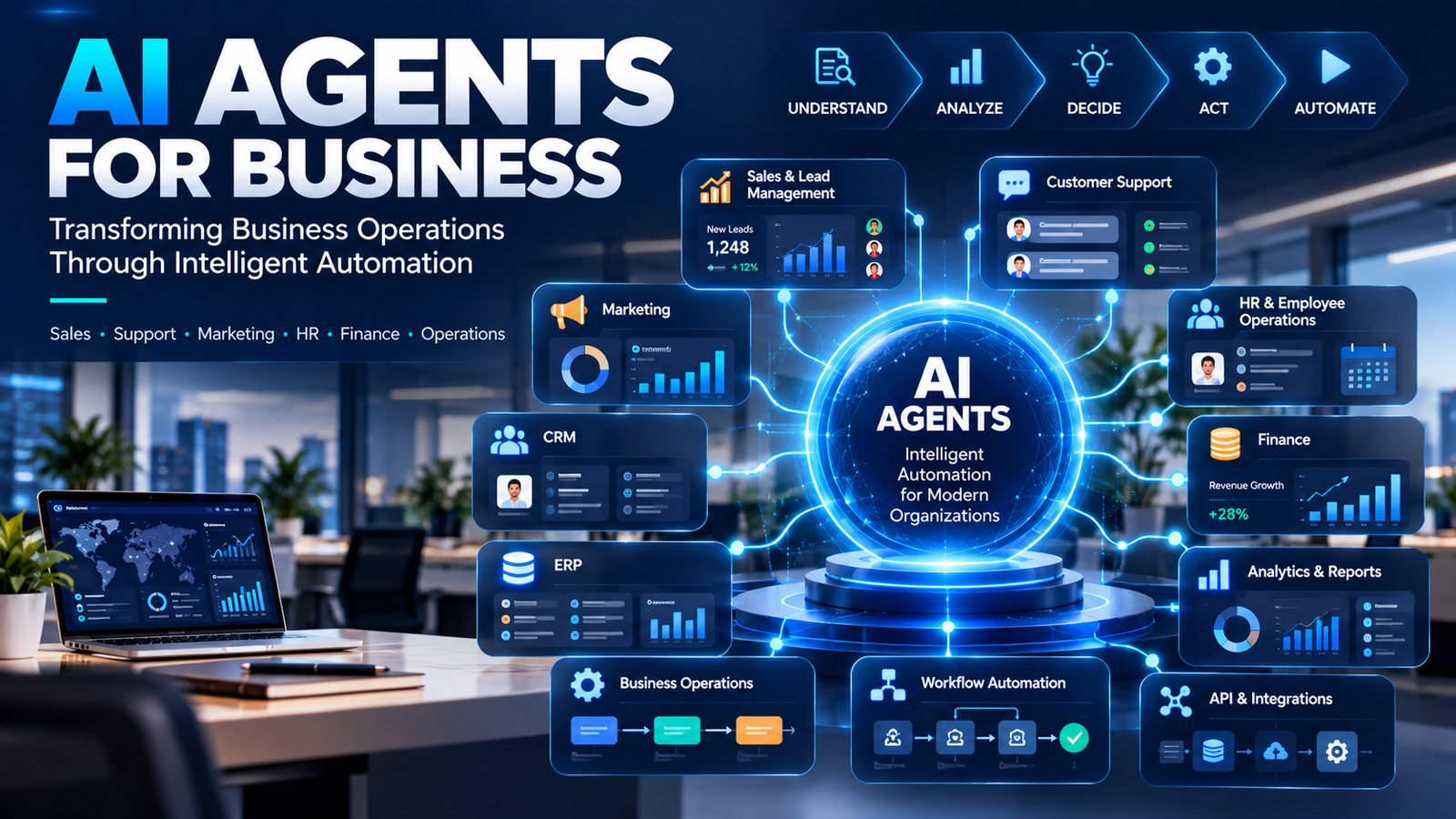
Business Platform + Multiple AI Agents
→ Sales Agent
→ Support Agent
→ Marketing Agent
→ Operations Agent
→ Finance Agent
This could lead to increasingly connected AI-powered business operations, where specialized agents work alongside employees and software systems.
However, the businesses that benefit from this technology will not necessarily be those that deploy the most AI.
They will be the ones that identify the right processes, establish appropriate controls, connect reliable data, and use AI where it creates measurable operational value.
Frequently Asked Questions About AI Agents for Business
What are AI agents for business?
AI agents for business are software systems designed to understand business objectives, process information, use connected tools, and perform defined tasks with varying levels of human supervision.
What is the difference between an AI agent and a chatbot?
A chatbot primarily focuses on conversational interaction. An AI agent can be designed to go beyond conversation by using tools, accessing approved information, making workflow decisions, and executing multi-step tasks.
Can AI agents automate business processes?
Yes. AI agents can assist with business processes that involve information gathering, interpretation, communication, workflow coordination, and other defined actions. The level of automation depends on the workflow and system integrations.
Can AI agents work with CRM and ERP systems?
Yes. With appropriate APIs, integrations, permissions, and architecture, AI agents can interact with CRM, ERP, HRMS, databases, and other business systems.
Are AI agents suitable for small businesses?
Yes. Small businesses can begin with focused use cases such as lead qualification, customer support, internal knowledge access, document processing, or follow-up assistance rather than attempting to automate the entire organization.
Do AI agents replace employees?
Not necessarily. AI agents are often more useful as productivity and workflow tools that reduce repetitive work while employees continue handling judgment, relationships, strategy, approvals, and complex situations.
Are AI agents secure?
Security depends on how the system is designed and deployed. Access controls, authentication, authorization, data protection, monitoring, secure integrations, and human approval mechanisms are important considerations.
How much does AI agent development cost?
The cost depends on the agent's complexity, AI model usage, integrations, data requirements, security requirements, infrastructure, workflow complexity, and ongoing maintenance. A simple internal agent and a multi-system enterprise agent can have very different requirements.
How should a business start with AI agents?
Start with one measurable business problem. Map the existing workflow, identify suitable AI opportunities, define permissions and human oversight, integrate the required systems, test the workflow, measure results, and expand gradually.
Final Thought: AI Should Improve the Business, Not Complicate It
AI agents represent an important shift in how businesses can approach automation.
Traditional automation helped organizations move from manual processes to rule-based digital workflows.
AI agents can take the next step by helping businesses handle workflows that require interpretation, context, coordination, and adaptive decision-making.
But successful AI adoption is not about adding AI to every department.
It is about identifying the right problems.
A business may start with one sales workflow, one customer-support process, one HR workflow, or one operational bottleneck.
Then, as the organization learns what works, AI capabilities can gradually expand across its technology ecosystem.
The strongest foundation remains the same:
Clear business processes + reliable data + secure systems + meaningful integrations + appropriate human oversight.
AI becomes valuable when those foundations come together.
Build Smarter Business Operations With AI
If your business is spending significant time on repetitive tasks, disconnected systems, manual follow-ups, customer enquiries, document processing, or operational coordination, AI-powered automation may be worth exploring.
Nexiva Technologies helps businesses evaluate technology opportunities across AI/ML solutions, business automation, custom software, CRM, ERP, web applications, cloud solutions, and digital transformation.
Instead of implementing AI simply because it is trending, the focus should be on identifying where intelligent automation can create practical business value.
Explore AI-powered business solutions and discover how AI agents can fit into your existing workflows, systems, and growth strategy.
Nexiva Technologies
https://nexivatechnologies.in/
NexivaGen Technology Solutions
https://landing.nexivatechnologies.in/
Build smarter workflows. Connect your systems. Automate what matters.