


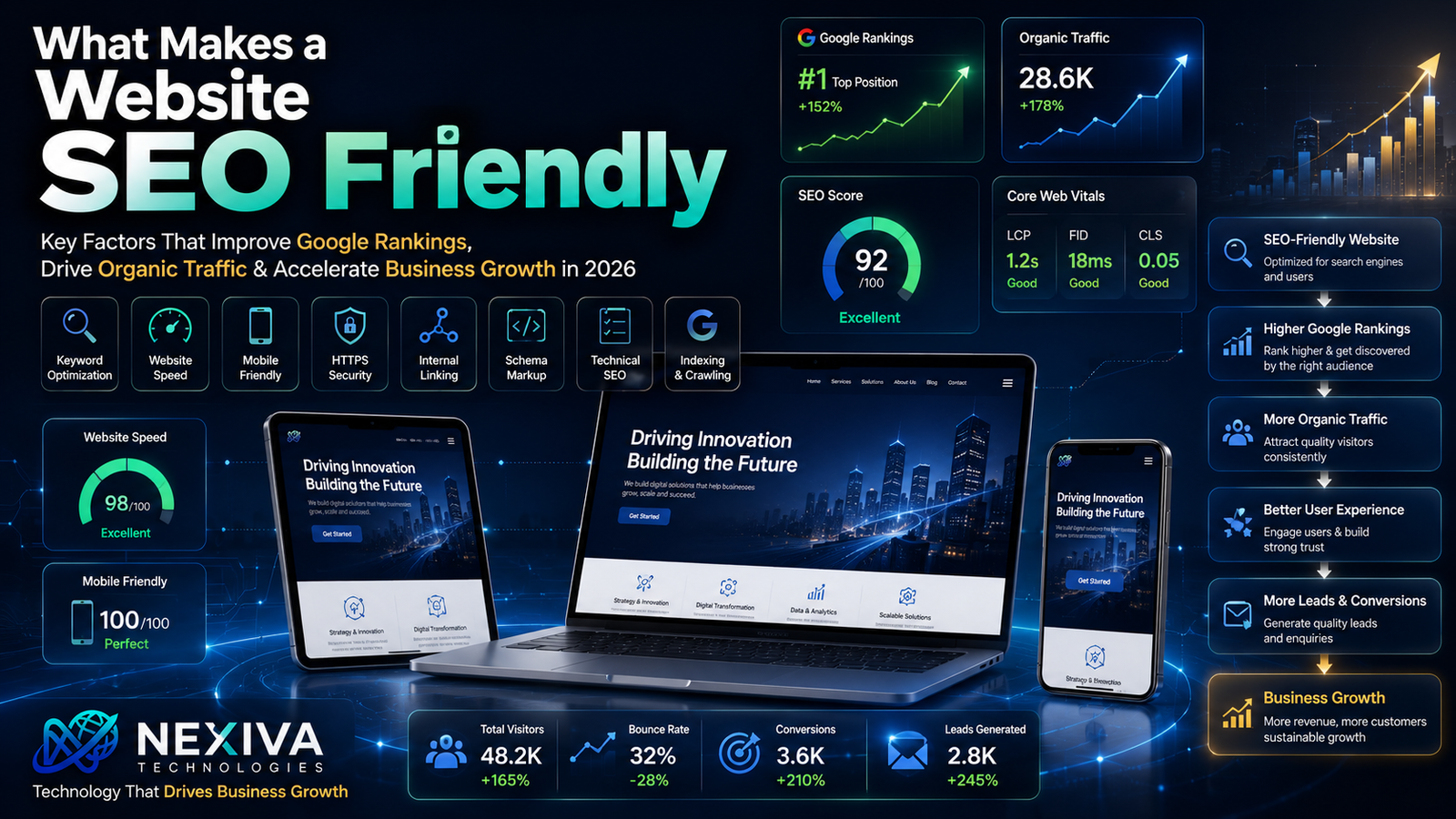
What Makes a Website SEO Friendly
Introduction
In today's competitive digital landscape, simply having a website is not enough. Businesses need websites that can be easily found by potential customers through search engines like Google.
This is where SEO-friendly website development becomes essential.
An SEO-friendly website is designed and optimized to help search engines understand its content, improve rankings, increase visibility, and attract qualified visitors.
In 2026, businesses that invest in SEO-friendly websites gain a significant advantage by generating more organic traffic, improving lead generation, and building stronger online authority.
Understanding what makes a website SEO friendly can help businesses maximize their online presence and long-term digital growth.
Fast Website Speed
Website speed is one of the most important SEO ranking factors.
Users expect websites to load quickly. Slow websites create poor user experiences and increase bounce rates.
Google favors websites that provide faster loading times because they offer better experiences for users.
A fast website helps:
- Improve Google rankings
- Reduce bounce rates
- Increase page engagement
- Improve conversion rates
- Enhance customer satisfaction
Website speed optimization should include:
- Image compression
- Browser caching
- Quality hosting
- Clean coding
- Performance optimization
Fast websites perform better in both search rankings and lead generation.
Mobile-Friendly Design
Most internet users now browse websites using smartphones.
Google uses mobile-first indexing, which means it primarily evaluates the mobile version of a website for rankings.
An SEO-friendly website must be:
- Mobile responsive
- Easy to navigate
- Fast loading on mobile devices
- User-friendly across all screen sizes
Responsive website design improves both user experience and search engine performance.
Businesses with mobile-friendly websites are more likely to rank higher and attract mobile visitors.
High-Quality Content
Content is one of the foundations of SEO.
Search engines prioritize websites that provide valuable, relevant, and informative content.
SEO-friendly websites publish:
- Service pages
- Blog articles
- Industry guides
- FAQs
- Educational resources
Quality content helps businesses:
- Target keywords
- Answer customer questions
- Build authority
- Improve rankings
- Increase organic traffic
Content should be written for users first while naturally incorporating SEO keywords.
Optimized Keywords
Keywords help search engines understand what a webpage is about.
SEO-friendly websites perform keyword research and strategically use keywords in:
- Page titles
- Meta descriptions
- Headings
- URLs
- Content
- Image alt text
Keyword optimization helps businesses rank for relevant search queries and attract targeted visitors.
However, keywords should be used naturally without excessive repetition.
Effective Meta Titles and Meta Descriptions
Meta titles and descriptions help search engines and users understand page content.
Well-optimized meta elements improve:
- Search visibility
- Click-through rates
- User engagement
A strong meta title should contain the target keyword and clearly describe the page.
Meta descriptions should summarize content while encouraging users to click.
These elements play an important role in SEO performance.
Proper Website Structure
Search engines prefer websites with organized structures.
An SEO-friendly website includes:
- Clear navigation
- Logical page hierarchy
- Internal linking
- Easy-to-follow layouts
A structured website helps both users and search engines find information efficiently.
Good website architecture improves indexing and user experience.
Technical SEO Optimization
Technical SEO ensures search engines can properly crawl and index a website.
Important technical SEO factors include:
- XML sitemap
- Robots.txt file
- Secure HTTPS connection
- Structured data
- Clean URLs
- Crawlability
Technical optimization helps search engines understand website content and improve rankings.
Without proper technical SEO, even high-quality content may struggle to rank effectively.
Secure Website (HTTPS)
Website security is an important ranking factor.
Google prefers secure websites that use HTTPS encryption.
A secure website helps:
- Protect user information
- Build customer trust
- Improve credibility
- Support SEO performance
Businesses should always use SSL certificates and secure hosting environments.
Optimized Images
Images improve website engagement but can negatively affect performance if not optimized.
SEO-friendly websites optimize images by:
- Compressing file sizes
- Using descriptive file names
- Adding alt text
- Selecting modern image formats
Image optimization improves website speed and helps search engines understand visual content.
Proper image SEO can also increase traffic from image search results.
Strong User Experience (UX)
Google prioritizes websites that provide excellent user experiences.
An SEO-friendly website should be:
- Easy to navigate
- Visually appealing
- Fast
- Mobile responsive
- User focused
Good user experience encourages visitors to stay longer and engage more with content.
Positive engagement signals help improve search rankings.
Internal Linking Strategy
Internal links connect pages within a website.
SEO-friendly websites use internal linking to:
- Improve navigation
- Distribute page authority
- Help search engines discover content
- Increase user engagement
A strong internal linking strategy improves overall website SEO performance.
Lead Generation Features
An SEO-friendly website should not only attract traffic but also convert visitors into leads.
Important features include:
- Contact forms
- Inquiry forms
- Call-to-action buttons
- WhatsApp integration
- Consultation booking options
Combining SEO with conversion-focused design helps businesses maximize website performance.
Conclusion
An SEO-friendly website combines technical optimization, quality content, user experience, and performance improvements to achieve better search rankings.
Businesses that focus on:
- Website speed
- Mobile responsiveness
- Keyword optimization
- Technical SEO
- Content quality
- User experience
can improve visibility, attract more traffic, generate leads, and support long-term business growth.
In 2026, an SEO-friendly website is one of the most valuable digital assets a business can have.
FAQ Section
1. What is an SEO-friendly website?
An SEO-friendly website is a website designed to help search engines easily crawl, index, and rank content while providing excellent user experiences.
2. Why is website speed important for SEO?
Website speed improves user experience, reduces bounce rates, and is a Google ranking factor that can impact search visibility.
3. Does mobile responsiveness affect SEO?
Yes. Google uses mobile-first indexing, making mobile-friendly design essential for rankings.
4. How do keywords help SEO?
Keywords help search engines understand page topics and match content with relevant search queries.
5. What is technical SEO?
Technical SEO focuses on website structure, indexing, crawlability, security, and performance optimization.
6. Why is HTTPS important for SEO?
HTTPS improves security, customer trust, and is a recognized Google ranking factor.
7. How does content improve SEO?
High-quality content helps target keywords, answer user questions, build authority, and increase organic traffic.
8. What role do meta titles and descriptions play?
They improve search visibility and encourage users to click on search results.
9. Can an SEO-friendly website generate more leads?
Yes. Better rankings and improved user experiences help attract qualified visitors and increase conversions.
10. How often should SEO be updated?
SEO should be monitored and updated regularly to align with search engine algorithm changes and business goals.
Looking to build an SEO-friendly website that ranks higher on Google and generates more business leads?
Nexiva Technologies provides professional website development, SEO optimization, responsive web design, technical SEO, and digital growth solutions designed to improve online visibility, traffic, and lead generation.