


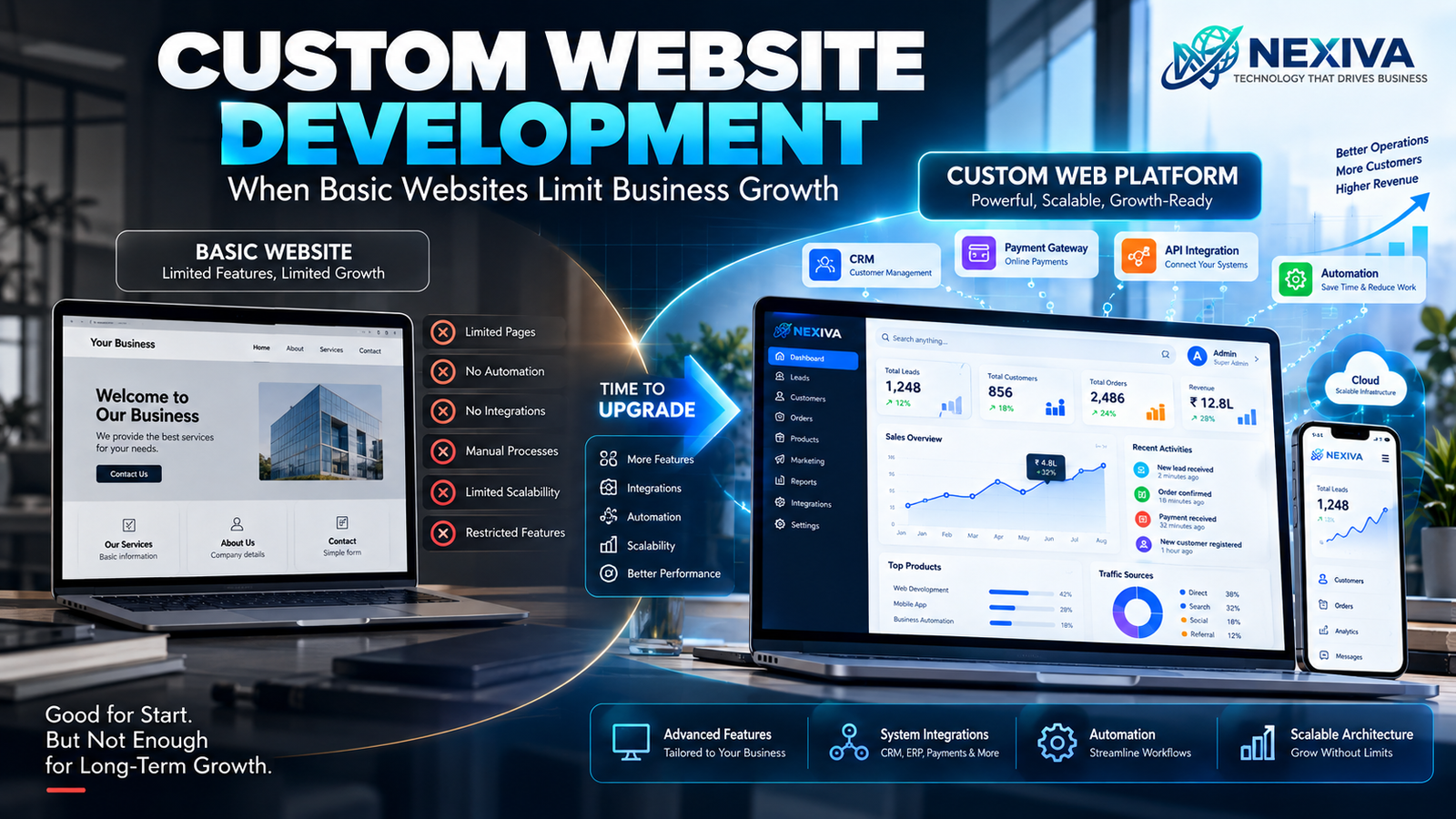
Why Businesses Outgrow Basic Websites: Custom WebDevelopment
A website can be enough to launch a business. But as the business grows, the same website can become the very thing holding it back.
A growing company may start with a simple template website, a few pages, a contact form, and basic hosting. At first, that may work perfectly well. But over time, business processes become more complex. More customers arrive. More employees need access. Marketing campaigns generate more leads. Teams start using CRM systems, payment gateways, booking platforms, ERP software, analytics tools, WhatsApp workflows, and other business applications.
Eventually, the question changes from “Do we have a website?” to “Can our website actually support the way our business operates?”
That is where custom website development becomes important.
A custom website is not simply a website with a different design. It is a digital platform developed around a company's specific business requirements, workflows, customers, integrations, scalability needs, and growth objectives.
For businesses that have outgrown basic websites, custom web development can create a more flexible foundation for lead generation, automation, integration, performance, and long-term digital growth.
Quick Answer: When Does a Business Need Custom Website Development?
A business should consider custom website development when its existing website can no longer support its business processes, customer experience, integrations, performance requirements, automation needs, or growth plans.
Common warning signs include:
- Your website cannot support new business features.
- You depend heavily on manual processes.
- Your website does not integrate with CRM, ERP, payment, booking, or other systems.
- Leads are being lost or followed up manually.
- Website performance decreases as traffic increases.
- Your business needs role-based access or advanced functionality.
- You need a unique customer portal or dashboard.
- Your website requires frequent workarounds.
- Your competitors provide digital experiences your current website cannot deliver.
- Adding a new feature requires rebuilding or replacing major parts of the website.
If several of these situations apply, the problem may no longer be your website design. The underlying website architecture may simply not be designed for your current stage of business.
1. Signs Your Website Has Become a Business Limitation
A website should support your business rather than force your team to work around it.
As companies grow, several signs indicate that a basic website may no longer be sufficient.
1. You Keep Adding Manual Work
Suppose a customer submits an enquiry through your website.
Instead of the enquiry automatically entering a CRM, a team member copies the information into Excel, sends a WhatsApp message, creates a reminder, and manually updates the sales status.
The website is generating leads, but it is not supporting the complete workflow.
A customized website development approach can connect the website with internal systems and automate parts of this journey.
2. Your Website Cannot Connect With Other Systems
Businesses rarely operate using a single software platform.
You may need connections with:
- CRM software
- ERP systems
- Payment gateways
- Accounting software
- Inventory systems
- Booking platforms
- Email marketing tools
- WhatsApp or communication systems
- Shipping platforms
- Analytics platforms
- Customer portals
- Internal business applications
If your website cannot communicate with these systems efficiently, your team may be forced to transfer data manually.
3. Adding Features Becomes Difficult
A basic website may handle pages, forms, blogs, and simple enquiries.
But what happens when you need:
- Customer login
- Employee login
- Vendor portal
- Online booking
- Subscription management
- Product configurator
- Custom quotation system
- Advanced search
- Personalized dashboards
- Automated notifications
- Real-time reporting
If every new requirement requires complicated workarounds, it may be time to consider custom web solutions.
4. Your Website Does Not Reflect Your Business Model
Every business has different processes.
A manufacturing company does not operate like a school.
A healthcare organization does not operate like an ecommerce business.
A logistics company does not operate like a professional services firm.
A template website provides a general framework. Custom website development allows the digital experience to be designed around the actual business model.
2. Problems With Basic Websites
Basic websites are not inherently bad.
For startups, small businesses, portfolios, local services, and early-stage businesses, a simple website can be a practical starting point.
The problem begins when the business grows beyond what the website was designed to handle.
Common limitations include:
Limited customization
The website may restrict how features, workflows, pages, and customer journeys can be implemented.
Limited integrations
Connecting external systems may require additional plugins, workarounds, or manual processes.
Scalability limitations
A website designed for a small volume of users may require architectural changes as traffic and functionality increase.
Performance problems
Excessive plugins, inefficient code, poor hosting configuration, or unoptimized assets can affect user experience.
Security concerns
Poorly maintained themes, plugins, libraries, or integrations can increase security risks.
Limited automation
Important business processes may continue to depend on manual work.
Poor data flow
Information may remain scattered across forms, spreadsheets, email, messaging applications, and separate software systems.
The result is often more operational complexity.
3. When Does Custom Development Become Necessary?
Custom development becomes increasingly relevant when the website has to perform a business function rather than simply display information.
For example, a company may need a website that:
- receives enquiries
- qualifies leads
- connects customers with sales teams
- accepts payments
- manages subscriptions
- connects to CRM
- connects to ERP
- manages appointments
- provides customer accounts
- generates quotations
- processes applications
- displays personalized information
- automates notifications
- supports internal workflows
At this point, the website is no longer just a marketing asset.
It becomes part of the company's digital infrastructure.
That is where custom website development can provide substantially more flexibility.
4. Custom Website vs Template Website
The difference is not simply about appearance.
The more important difference is how the website is designed to support the business.
| Area | Basic / Template Website | Custom Website |
|---|---|---|
| Design | Predefined structure | Business-specific design |
| Functionality | General-purpose | Requirement-specific |
| Integrations | Often limited | Designed around required systems |
| Automation | Basic | Advanced workflow possibilities |
| Scalability | Depends on platform | Architecture can be planned for growth |
| Customer Experience | Standard | Customized |
| Business Logic | Limited | Custom business rules |
| Performance | Depends on setup | Can be optimized around requirements |
| Security | Platform-dependent | Security architecture can be designed around needs |
| Future Development | May become restrictive | Can be extended systematically |
The right choice depends on the business stage, budget, complexity, technical requirements, and expected growth.
A small brochure website does not necessarily need a custom architecture.
A growing business with complex workflows may.
5. Scalability: Building for the Next Stage of Growth
One of the biggest reasons businesses move toward custom website development is scalability.
Imagine a business starts with 500 monthly visitors.
A year later, marketing campaigns, SEO, social media, partnerships, and referrals bring significantly more traffic.
At the same time, the company adds:
- more products
- more customers
- more employees
- more transactions
- more integrations
- more content
- more business processes
A website that was built only for the initial stage may struggle to accommodate these changes.
Custom web development allows the architecture to be planned around current requirements and foreseeable future needs.
This can include:
- modular functionality
- scalable database design
- optimized backend architecture
- API-based integrations
- caching strategies
- cloud-ready infrastructure
- role-based access
- performance optimization
The objective is not to overbuild the website.
The objective is to create an architecture that can evolve with the business.
6. Integrations: Connecting Your Digital Ecosystem
Modern businesses rarely operate in isolation.
A website may need to communicate with several systems.
For example:
Website → CRM → Sales Team → Customer
or
Website → Payment Gateway → Order System → ERP → Accounting
or
Website → Booking System → Calendar → Notifications → Customer
Without integration, employees may need to manually move information between systems.
With appropriate APIs and system integrations, information can move between platforms automatically.
Custom website development is particularly useful when standard plugins or connectors cannot support the exact workflow required by the business.
This is where custom web solutions can become more valuable than simply adding another plugin.
7. Automation: Turning the Website Into a Business Tool
A modern business website can do more than collect contact information.
It can initiate automated workflows.
For example:
Lead Generation Workflow
Visitor submits enquiry
↓
Website validates information
↓
Lead enters CRM
↓
Sales team receives notification
↓
Lead is assigned automatically
↓
Follow-up reminder is created
↓
Customer receives confirmation
↓
Sales pipeline is updated
This type of workflow reduces repetitive administrative work and can help teams respond more consistently.
The website becomes part of the business process instead of remaining separate from it.
8. Security Should Grow With the Business
Security becomes increasingly important as websites begin handling more sensitive information.
A business website may process:
- Customer information
- Contact details
- Login credentials
- Payment information
- Business documents
- Internal data
- Application information
- Transaction records
Custom development allows security requirements to be considered as part of the architecture.
Depending on the application, this may include:
- secure authentication
- role-based access
- input validation
- secure API communication
- encryption where appropriate
- session management
- access controls
- secure database practices
- logging and monitoring
- regular dependency updates
- backup and recovery planning
Security should not be treated as something to add only after a problem occurs.
It should be considered during planning and development.
9. Performance: Speed Is Part of the Customer Experience
A technically impressive website is not useful if customers struggle to use it.
Performance can influence:
- user experience
- engagement
- conversion opportunities
- mobile usability
- operational efficiency
Google's current guidance also emphasizes overall page experience, including mobile usability, secure delivery, and Core Web Vitals, while noting that no single metric guarantees top rankings.
For a custom website, developers can optimize areas such as:
- frontend assets
- database queries
- API requests
- image delivery
- caching
- server configuration
- code structure
- responsive behavior
Performance should therefore be considered a business requirement, not merely a technical metric.
10. Custom Development and Lead Generation
A website should not only look professional.
It should guide visitors toward meaningful actions.
Depending on the business, those actions may include:
- Request a quote
- Book an appointment
- Schedule a consultation
- Submit an enquiry
- Register for a service
- Start a free trial
- Purchase a product
- Contact sales
- Download a resource
Custom development can allow these journeys to be designed around the company's actual sales process.
For example, instead of a generic contact form, a business could build a structured enquiry process that captures:
Requirement → Budget Range → Location → Business Type → Service Needed → Contact Details
That information can then be connected to CRM or internal workflows.
This creates a more useful connection between website traffic and sales operations.
11. What Is the ROI of Custom Website Development?
The return on a custom website should not be measured only by website traffic.
A better evaluation considers the business outcomes the website supports.
Potential areas include:
Lead Quality
Does the website capture information that helps sales teams understand prospects?
Conversion
Does the website make it easier for visitors to take the desired action?
Productivity
Does automation reduce repetitive administrative tasks?
Customer Experience
Can customers access information or services more conveniently?
Operational Efficiency
Does integration reduce duplicate data entry?
Scalability
Can the system support additional users, services, products, or workflows?
Business Visibility
Can the website provide better analytics and reporting about customer activity?
The actual ROI will depend on the business model, implementation quality, adoption, traffic, conversion rates, operating costs, and other factors.
Therefore, custom development should be evaluated as a business investment, not simply as a design expense.
12. Who Needs Custom Websites?
Custom website development may be particularly relevant for:
Growing SMEs
Businesses that have moved beyond basic online presence and require stronger digital processes.
Service Businesses
Companies that need quotation systems, appointment booking, lead management, customer portals, or workflow automation.
Ecommerce Businesses
Businesses requiring customized product experiences, payment workflows, inventory connections, or third-party integrations.
Manufacturing Companies
Organizations connecting websites with ERP, product catalogues, enquiry systems, distributors, or internal operations.
Education Businesses
Schools, coaching institutes, training organizations, and education companies requiring admissions, applications, student portals, payments, or communication systems.
Healthcare Organizations
Hospitals, clinics, and healthcare businesses requiring appointment systems, patient-facing applications, portals, or integration with healthcare software.
Logistics Businesses
Companies requiring shipment tracking, customer dashboards, booking systems, logistics workflows, and integrations.
Startups Building Digital Products
Startups developing marketplaces, SaaS products, platforms, portals, or technology-enabled business models may require a more flexible technical foundation from the beginning.
13. How to Know If Your Business Is Ready
Ask these questions:
- Does our current website support our business processes?
- Are employees performing website-related tasks manually?
- Do we need CRM or ERP integration?
- Do we need customer or employee login?
- Are we losing leads because follow-up is manual?
- Do we need custom workflows?
- Is the current website difficult to scale?
- Do we need advanced reporting or dashboards?
- Are customers asking for digital features our website cannot provide?
- Will our requirements become more complex over the next 2–3 years?
If several answers are yes, it may be worth evaluating a custom development approach.
14. How to Approach Custom Website Development
A successful project should start with business requirements rather than technology alone.
Step 1: Understand the Business
Identify customers, processes, services, challenges, and growth objectives.
Step 2: Define the Website's Role
Determine whether the website is primarily for:
- marketing
- lead generation
- ecommerce
- customer service
- operations
- automation
- a digital product
- a combination of these
Step 3: Map the User Journey
Understand what customers need to do from their first visit through conversion and post-sale interaction.
Step 4: Identify Integrations
Document required CRM, ERP, payment, communication, analytics, accounting, booking, or other systems.
Step 5: Prioritize Features
Separate essential features from future requirements.
Step 6: Plan the Architecture
Choose the technology stack and architecture based on requirements, security, scalability, performance, and maintainability.
Step 7: Develop, Test and Optimize
Build the system, test functionality and security, optimize performance, and validate the user experience.
Step 8: Measure Business Outcomes
Track leads, conversions, engagement, operational efficiency, and other relevant KPIs after launch.
Frequently Asked Questions
What is custom website development?
Custom website development is the process of designing and developing a website specifically around a business's unique requirements, workflows, functionality, integrations, customer journeys, and scalability needs.
Is custom website development better than a template website?
They serve different requirements. A template website can be suitable for businesses with straightforward needs, while custom website development can provide greater flexibility when a business requires specialized functionality, integrations, automation, or scalability.
When should a business switch from a basic website to a custom website?
Consider the transition when the existing website cannot efficiently support business processes, customer requirements, integrations, automation, performance needs, or future growth.
How does custom web development help lead generation?
Custom development can create tailored lead capture forms, conversion journeys, CRM integrations, automated notifications, qualification workflows, booking systems, and personalized experiences.
Can a custom website integrate with CRM and ERP systems?
Yes. Depending on the systems involved, websites can integrate with CRM, ERP, payment gateways, accounting platforms, booking systems, communication tools, analytics platforms, and other business applications through APIs and other integration methods.
Is custom website development suitable for small businesses?
It can be, particularly when the business has specific workflows or growth requirements that standard website platforms cannot efficiently support. However, businesses with simple requirements may not need a fully custom solution.
Does custom development improve website SEO?
Custom development can provide better control over technical architecture, performance, information structure, URLs, metadata, structured data, and other SEO-related implementation areas. However, development alone does not guarantee higher rankings. Search visibility also depends on content quality, relevance, authority, technical health, competition, user experience, and other factors.
Final Thought
Your first website may have been built simply to establish an online presence.
Your next website may need to do much more.
It may need to generate qualified leads, connect business systems, automate workflows, support customers, process transactions, provide dashboards, integrate with internal software, and scale as your organization grows.
That is the point where a website stops being just a digital brochure and becomes part of your business infrastructure.
Custom website development is not about adding more features simply because they are possible. It is about building the right digital capabilities around the way your business actually works.
If your current website is becoming difficult to extend, integrate, manage, or scale, it may be time to evaluate what a customized digital platform could look like.
For businesses exploring custom website development, customized website development, scalable web solutions, and business-focused digital platforms, Nexiva Technologies provides technology solutions designed around specific business requirements.
You can also explore Nexiva's technology solutions to understand how custom websites, web applications, business automation, CRM, ERP, AI/ML, and other digital solutions can support different business needs.
Build Beyond a Basic Website
Your website should not limit your business growth. It should be built to support it.