


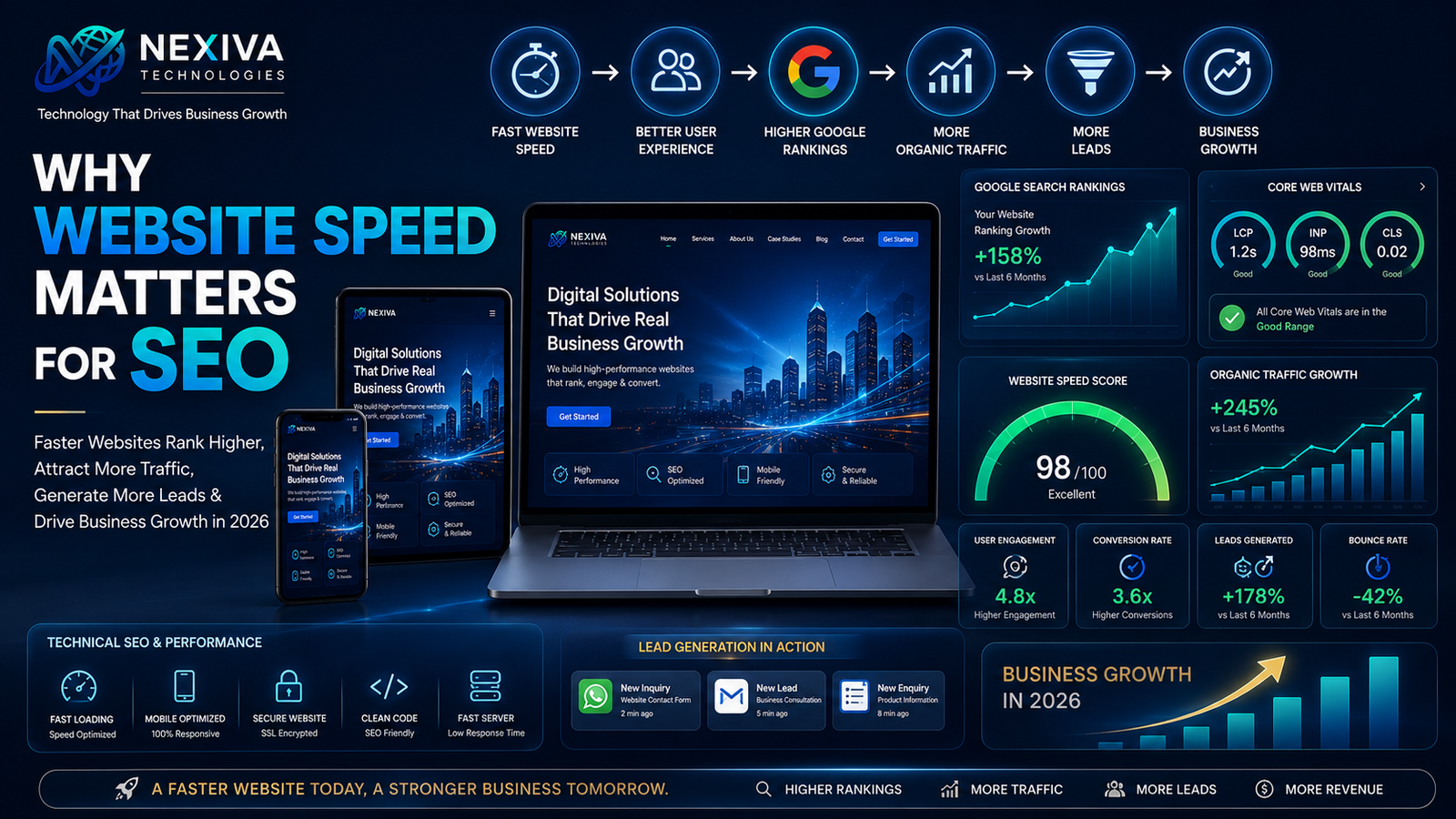
Why Website Speed Matters for SEO
Website speed is one of the most important Google ranking factors, influencing SEO performance, user experience, lead generation, and online business growth.
Introduction
In today's digital landscape, website speed is no longer just a technical feature. It is a critical factor that directly affects search engine rankings, user experience, lead generation, and business success.
Google's goal is to provide users with the best possible experience. Because of this, websites that load quickly are often rewarded with better visibility in search results. Slow websites can frustrate visitors, increase bounce rates, and reduce conversions.
For businesses looking to improve their online presence in 2026, website speed optimization has become an essential part of SEO strategy.
What Is Website Speed?
Website speed refers to how quickly a webpage loads and becomes fully interactive for visitors.
A fast website allows users to access information immediately, while a slow website creates delays that negatively impact the browsing experience.
Website speed is influenced by:
- Hosting quality
- Image optimization
- Website code efficiency
- Server response times
- Caching implementation
- Third-party scripts
- Mobile performance
Optimizing these factors helps improve both user experience and SEO performance.
How Website Speed Affects SEO
Google has officially confirmed that website speed is a ranking factor.
Fast websites help search engines provide better experiences for users, which aligns with Google's objectives.
A fast website can help:
- Improve search rankings
- Increase organic traffic
- Reduce bounce rates
- Improve crawl efficiency
- Enhance page experience
Slow websites often struggle to compete against faster competitors in search results.
Core Web Vitals and SEO
Core Web Vitals are performance metrics used by Google to evaluate user experience.
Key Core Web Vitals include:
- Largest Contentful Paint (LCP)
- Interaction to Next Paint (INP)
- Cumulative Layout Shift (CLS)
These metrics measure:
- Loading performance
- Interactivity
- Visual stability
Improving Core Web Vitals helps websites achieve better SEO performance and user satisfaction.
Website Speed Improves User Experience
Visitors expect websites to load within seconds.
Fast-loading websites:
- Improve engagement
- Increase page views
- Encourage users to stay longer
- Reduce frustration
A positive user experience increases the likelihood that visitors will explore products, services, and content.
Lower Bounce Rates
Bounce rate measures how quickly visitors leave a website.
Slow websites often experience higher bounce rates because users lose patience.
Fast websites encourage users to:
- Visit additional pages
- Spend more time browsing
- Engage with content
- Contact the business
Lower bounce rates send positive signals to search engines and can contribute to better rankings.
Mobile Speed Is More Important Than Ever
Most internet users now browse through smartphones.
Google uses mobile-first indexing, making mobile performance critical.
Fast mobile websites help businesses:
- Improve mobile SEO
- Increase engagement
- Generate more leads
- Improve customer satisfaction
Responsive design combined with speed optimization creates better experiences across all devices.
Website Speed and Lead Generation
Website speed directly influences conversions.
Visitors are more likely to complete actions such as:
- Contact form submissions
- Quote requests
- Appointment bookings
- Product purchases
when websites load quickly and function smoothly.
Even small improvements in website speed can significantly increase lead generation and revenue.
Website Speed Builds Trust
A fast website creates a professional impression.
Customers often associate fast-loading websites with:
- Reliability
- Professionalism
- Security
- Credibility
Businesses with slow websites risk losing potential customers before meaningful engagement occurs.
Best Practices for Website Speed Optimization
Businesses can improve website speed by:
- Compressing images
- Using quality hosting
- Enabling browser caching
- Minimizing CSS and JavaScript
- Using Content Delivery Networks (CDNs)
- Optimizing databases
- Reducing unnecessary plugins
- Monitoring Core Web Vitals
Regular performance audits help maintain website speed over time.
Conclusion
Website speed is one of the most important factors influencing SEO success in 2026.
A fast-loading website helps businesses:
- Improve Google rankings
- Increase organic traffic
- Enhance user experience
- Reduce bounce rates
- Generate more leads
- Improve conversions
Investing in website speed optimization is not just about technical performance—it is about creating better user experiences and achieving long-term business growth online.
Frequently Asked Questions (FAQ)
Does website speed affect SEO?
Yes. Google considers website speed and user experience when ranking websites.
What is a good website loading speed?
Ideally, websites should load within 2–3 seconds.
What are Core Web Vitals?
Core Web Vitals are Google's performance metrics measuring loading speed, responsiveness, and visual stability.
Can a slow website reduce leads?
Yes. Slow websites often experience higher bounce rates and lower conversion rates.
Does mobile speed affect rankings?
Yes. Google uses mobile-first indexing, making mobile performance essential.
How can businesses improve website speed?
By optimizing images, upgrading hosting, enabling caching, and improving technical SEO.
Does website speed affect customer trust?
Yes. Fast websites create professional impressions and improve credibility.
Is website speed important for local businesses?
Absolutely. Faster websites improve local SEO performance and customer engagement.
Looking for a fast, SEO-friendly, and high-performance website?
Nexiva Technologies provides professional website development, speed optimization, technical SEO, and performance enhancement solutions designed to improve rankings, traffic, lead generation, and business growth.