


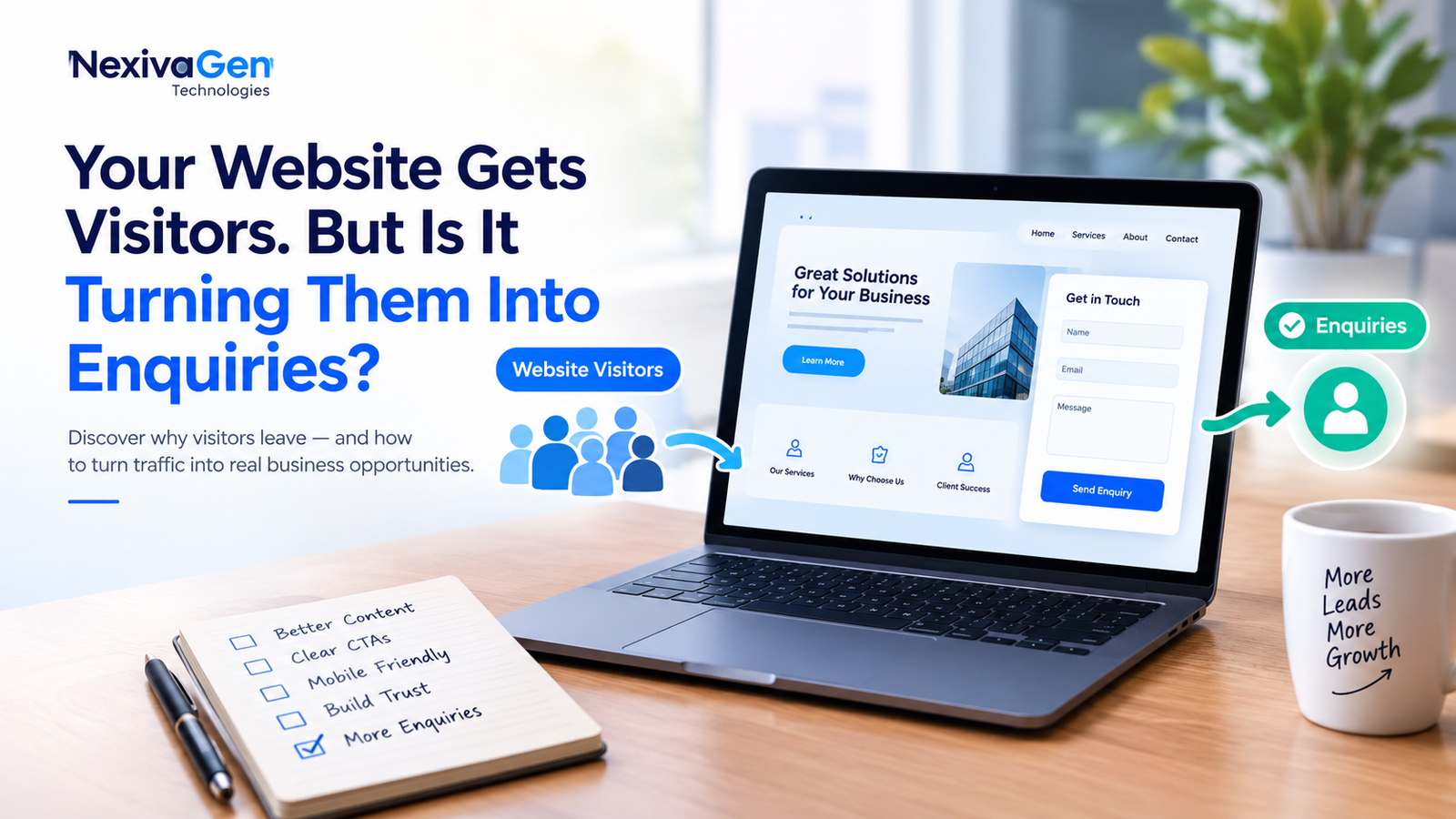
Your Website Gets Visitors. But Is It Turning Them Into Enqu
Your website is live. People are visiting it. Your services are listed, your business information is available, and your pages may even be receiving traffic from Google and social media.
But there is one important question: How many of those visitors are actually contacting your business?
For many businesses, the challenge is not simply attracting website visitors. It is helping the right visitors understand the offering, trust the business, and take the next step.
A website can look professional and still struggle to generate enquiries. Visitors may leave because they cannot quickly understand what the business offers, find the information they need, or determine how to get in touch.
The good news is that these problems can often be investigated and improved.
In this guide, we explore why a website may receive traffic without generating enough enquiries, how to identify potential conversion barriers, and what businesses can do to create a more effective website experience.
What Does It Mean for a Website to Generate Enquiries?
A website enquiry occurs when a visitor takes a meaningful action to express interest in a business's products or services.
Depending on the business model, this could mean completing a contact form, requesting a quotation, booking a consultation, calling the business, or sending a relevant message.
A successful enquiry is not necessarily the same as a sale. It is an opportunity to begin a conversation with a potential customer.
For example, a web development company might receive 1,000 website visits in a month. If only a small number of visitors submit enquiries, the business needs to understand why that gap exists before deciding what to change.
The visitors may not be the right audience. The website may not communicate the services clearly. The contact process may be difficult to use. Alternatively, visitors might be interested but not ready to make a decision.
These possibilities require different responses.
Website traffic measures visits. Enquiries indicate that visitors have taken a step towards doing business with you. Both matter, but they tell you different things about performance.
1. Your Website Does Not Clearly Explain What You Offer
When someone lands on your website, they should be able to understand what your business does, whom it serves, and how it may help them.
If the homepage uses vague statements, generic marketing language, or technical terminology without explaining the business benefit, visitors may struggle to determine whether the offering is relevant to them.
Imagine a business owner looking for a company to develop an online store. They arrive at a website that says, “Delivering innovative digital excellence.”
The statement may sound professional, but it does not explain whether the company develops e-commerce websites, what services it provides, or how the visitor can proceed.
A clearer message would explain the service and its relevance to the intended customer.
How to improve it
-
State your main service clearly near the top of the page.
-
Explain who the service is designed for.
-
Describe the business problem the service addresses.
-
Use straightforward language instead of unnecessary jargon.
-
Provide a clear next step, such as requesting a consultation or discussing requirements.
Your website does not need to explain everything in the first paragraph. It needs to give visitors enough information to decide whether they should continue exploring.
2. Your Calls to Action Are Difficult to Find
A visitor may understand your service and still leave without enquiring if the next step is unclear.
A call to action (CTA) guides visitors towards an intended action. Examples include “Request a Quote,” “Discuss Your Project,” “Book a Consultation,” and “Contact Our Team.”
A common problem is using generic labels that provide little context or placing contact options where visitors are unlikely to notice them.
Another issue occurs when a page contains too many competing actions. Visitors may be unsure whether to call, complete a form, download a document, create an account, or navigate elsewhere.
How to improve it
Choose a primary action that matches the purpose of each page.
A service page could invite visitors to discuss their requirements. A product page might encourage a demonstration request. A landing page for a specific campaign should have an action directly related to the offer.
Make the CTA visually noticeable, use clear wording, and ensure that the destination works correctly.
The objective is not to place a button after every paragraph. It is to make the next step obvious at the point where a visitor is likely to need it.
3. Your Website Is Difficult to Use on Mobile
Many people discover businesses through mobile searches, social media links, messaging applications, and other mobile experiences.
If a website is difficult to navigate on a phone, potential customers may leave before they reach the information or contact options they need.
Common problems include text that is too small, buttons that are difficult to tap, overlapping page elements, forms that are frustrating to complete, and important information that is difficult to find.
A page may look excellent on a desktop computer but provide a poor experience on a smaller screen.
How to improve it
Review the complete enquiry journey on a mobile device.
Check whether visitors can understand the main message without excessive scrolling, navigate the service pages comfortably, read the text, and complete forms without difficulty.
Ensure that phone numbers and email links work correctly where provided. Test menus, buttons, embedded elements, and form submissions.
A mobile-friendly website should make the same essential information and actions accessible without forcing visitors to work around the design.
4. Slow Pages and Technical Problems Create Friction
Website performance influences the experience visitors have when they arrive.
Pages that take too long to become usable, images that load poorly, broken links, malfunctioning forms, and persistent layout problems can interrupt the customer journey.
Even a well-designed contact form is ineffective if it fails to submit enquiries reliably.
However, performance should be investigated rather than assumed to be the reason for low enquiries. A website may load quickly and still struggle because its content does not match what visitors need.
How to improve it
Start by testing important pages, particularly the homepage, high-value service pages, landing pages, and contact page.
Review mobile performance, image sizes, unnecessary scripts, server response, broken links, and form behaviour. Tools such as Google PageSpeed Insights can help identify performance issues and opportunities for improvement.
Test important forms from beginning to end. Confirm that submissions are received, confirmation messages appear, and the relevant team can access the enquiry.
Fix the issues that materially affect usability and the ability to contact your business before making unnecessary design changes.
5. Your Website Does Not Establish Enough Trust
Before contacting a business, visitors may want to know whether it is credible, experienced, relevant to their needs, and likely to respond professionally.
If a website provides little information about the company, offers unclear service descriptions, or makes unsupported claims, visitors may hesitate.
Trust is particularly important when the service involves a substantial investment, access to business information, or an ongoing working relationship.
How to improve it
Provide accurate, useful information that helps visitors evaluate your business.
Depending on what is available, this might include:
-
A clear company introduction and service information.
-
Relevant project examples or verified case studies.
-
Genuine client testimonials used with permission.
-
A professional contact page and appropriate business details.
-
Transparent descriptions of the process and scope of services.
-
Clear privacy information where visitors submit personal data.
Do not invent client logos, testimonials, certifications, awards, or performance results to make a website appear more established.
Credibility is built through accurate information and evidence that visitors can reasonably evaluate.
6. Your Enquiry Form Asks for Too Much Information
Contact forms help businesses collect the information they need to respond to potential customers. But an unnecessarily complicated form can discourage submissions.
A visitor who wants to request a consultation may not be ready to complete a long questionnaire about budgets, internal processes, company size, technical specifications, and other details.
The right amount of information depends on the service and the type of enquiry.
For a straightforward consultation, a short form requesting a name, contact method, and brief description of the requirement may be sufficient. A complex project quotation may need additional details to determine whether the request is suitable.
How to improve it
Ask only for information that serves a clear purpose at the initial stage.
Use descriptive field labels, make required fields obvious, provide helpful error messages, and ensure that the form works on mobile devices.
If more detailed information is necessary, consider collecting it after the initial enquiry or through a clearly explained, staged process.
Also consider what happens after submission. Tell visitors what to expect next and ensure the enquiry reaches the right person.
7. Your Website Attracts the Wrong Audience
Not every website visitor is a potential customer.
Some people may be researching a general topic, looking for employment, comparing unrelated services, or seeking information that your business does not provide.
A website can attract significant traffic while receiving few relevant enquiries if its content and search visibility do not align with the services it actually offers.
For example, a company providing custom business software may attract visitors searching for free templates or introductory tutorials. Those visits may be useful for awareness, but they do not necessarily indicate immediate buying intent.
How to improve it
Review which search queries, landing pages, campaigns, and referral sources bring visitors to your website.
Ensure that each important service page addresses the needs of the audience you want to reach. Use accurate page titles, specific service descriptions, relevant content, and calls to action appropriate to the visitor's intent.
For paid campaigns, check whether the advertisement's promise matches the landing page. For organic search, review whether the content answers the question the visitor is actually trying to resolve.
The objective is not to attract every possible visitor. It is to attract relevant visitors and help them determine whether your business is the right fit.
8. Your Website Does Not Guide Visitors Through Their Decision
Visitors rarely make every decision immediately.
Someone discovering your business for the first time may need to understand the service before contacting you. Another visitor may already be comparing providers and want to see project examples, implementation details, or a way to discuss requirements.
If every page presents the same generic message, the website may fail to support visitors at different stages of their decision-making process.
How to improve it
Organize your content around the questions visitors are likely to have.
Your homepage should communicate the business offering and guide people towards relevant sections. Service pages should explain what you provide, whom it helps, and how the process works. Supporting articles can answer common questions. A contact page should make it easy to start a conversation.
Internal links should connect related information so that visitors can explore naturally rather than repeatedly returning to the homepage.
For businesses with distinct services or customer segments, dedicated service pages or focused landing pages may be more appropriate than trying to explain every offering on a single page.
9. You Are Measuring Traffic but Not Enquiry Performance
One of the most important steps in improving website conversions is understanding what happens after visitors arrive.
Page views and visitor counts can reveal whether people are reaching your website. They cannot, on their own, explain why people do or do not contact you.
Businesses need to consider the actions that matter to their objectives.
Depending on the website, these may include completed contact forms, quotation requests, consultation bookings, tracked phone calls, or other meaningful enquiry events.
How to improve it
Use suitable analytics and enquiry tracking to understand the customer journey.
Google Analytics 4 can help measure configured events and user interactions. Google Search Console can show how your website appears in Google Search and which queries generate impressions and clicks. Form records and customer management systems can help connect enquiries to subsequent business activity.
Review the data together rather than relying on a single metric.
For example, a service page might receive traffic but few CTA clicks. Another page may receive fewer visits but generate more relevant enquiries. These patterns can help identify where further investigation is worthwhile.
Make sure tracking is configured correctly, respect applicable privacy requirements, and avoid collecting personal information in analytics events where it is not appropriate.
How to Calculate Your Website Enquiry Conversion Rate
A conversion rate can help you understand how frequently visitors complete a particular action.
For a simple website enquiry calculation:
Enquiry conversion rate = (Number of completed enquiries ÷ Number of website visitors) × 100
For example, if a website receives 1,000 visitors during a defined period and records 20 completed enquiries, the visitor-based enquiry conversion rate is 2%.
This is an illustrative example, not an industry benchmark or a prediction of what your website should achieve.
Be consistent about what you count. Some businesses calculate conversion using sessions, while others use unique visitors or a specific landing-page audience. The results are not directly interchangeable.
You should also distinguish total enquiries from qualified enquiries. A high number of irrelevant submissions may not represent better business performance.
The most useful measurement approach reflects the actual objective of the website and the quality of the opportunities it generates.
A Practical Website Conversion Checklist
Before investing in a complete redesign, review these fundamentals.
-
Can a new visitor understand your main service quickly?
-
Does each important service page explain the value of the offering?
-
Are the primary calls to action clear and relevant?
-
Does the website work properly on mobile devices?
-
Do important pages load reliably?
-
Are forms simple enough to complete?
-
Does the website provide accurate trust signals?
-
Are the visitors arriving from relevant search queries and campaigns?
-
Can you measure completed enquiries and identify their sources?
-
Does your team have a process for responding to new enquiries?
Use this checklist to identify specific problems rather than assuming that every website needs the same solution.
Prioritize issues based on their likely impact, available evidence, implementation effort, and business importance.
When Should You Consider a Website Redesign or Custom Development?
Not every website conversion problem requires a complete redesign.
Sometimes, improving service descriptions, updating calls to action, simplifying a form, or fixing a technical issue may be sufficient.
A landing page may be appropriate when you need a focused destination for a particular service, audience, or campaign. A website redesign may make sense when the overall structure, user experience, content, or technology no longer supports the business's requirements.
Custom web development may be relevant when standard website functionality cannot reasonably support a necessary workflow, integration, customer portal, or business process.
The right decision should follow an assessment of the actual problem.
At NexivaGen Technologies, our services include website design and development, website redesign, landing page development, web applications, and customized software solutions. The appropriate approach depends on your business objectives, existing website, users, and technical requirements.
The goal should be to solve the underlying problem—not to purchase more technology simply because it is available.
Frequently Asked Questions
Why is my website getting traffic but no enquiries?
Possible reasons include unclear service messaging, weak calls to action, poor mobile usability, technical issues, insufficient trust information, complicated forms, or traffic that does not match your target audience. Review website behaviour and enquiry data to identify which issues are relevant to your situation.
How can I get more enquiries from my business website?
Start by making your offering clear, improving the mobile experience, providing relevant trust information, simplifying contact options, and measuring completed enquiries. Prioritize changes based on evidence rather than assuming that one design change will solve every problem.
Does a website redesign guarantee more leads?
No. A redesign can address problems with structure, content, usability, or technology, but results depend on many factors, including visitor intent, the offer, competition, traffic quality, and implementation. Define measurable objectives and evaluate performance after changes.
What is a good website enquiry conversion rate?
There is no single rate that applies to every business. Results vary by industry, audience, service price, traffic source, device, and the type of conversion being measured. Establish a reliable baseline for your own website and assess the quality of the enquiries as well as their quantity.
Should I invest in SEO or improve my website conversion rate first?
It depends on the current problem. If your website is attracting very few relevant visitors, improving search visibility and audience targeting may be a priority. If relevant visitors are arriving but struggling to enquire, investigate the website experience and conversion journey. In many cases, both areas need attention.
Do I need a landing page to generate enquiries?
Not always. A well-structured service page may be sufficient. A dedicated landing page can be useful when the message needs to match a particular campaign, audience, or offer. Choose the page structure that best supports the visitor's objective.
How do I know whether my website is generating qualified enquiries?
Track the enquiries received, their source, the services requested, and whether they match your target customer profile. If possible, connect website tracking with your sales or CRM process to understand which enquiries progress into meaningful business conversations.
Questions and Answers: Website Enquiry Optimization
Q1. What should I check first if my website is not generating leads?
Start with the main service page and contact journey. Check whether visitors understand your offer, can find the next step, and can complete the contact process successfully. Then review traffic relevance and analytics data.
Q2. Can better website design improve enquiries?
It can help when design changes improve clarity, navigation, mobile usability, accessibility, and the visibility of relevant actions. Design alone cannot guarantee enquiries, so it should be combined with suitable messaging, relevant traffic, and reliable tracking.
Q3. How long does it take to improve website conversions?
The timeframe depends on the problem, the changes required, the amount of traffic, and how reliably results can be measured. Technical fixes can sometimes be assessed quickly, while content, traffic quality, and larger redesigns may require a longer evaluation period.
Q4. What information should a business track after a website improvement?
Track relevant visits, completed enquiry actions, conversion rate, enquiry quality, and—where data is available—the progression of those enquiries into sales conversations. Choose metrics that reflect the original business objective.
Final Thoughts: Make Your Website Work Towards a Clear Business Goal
A website can be an important part of your business's customer journey, but simply attracting visitors does not guarantee meaningful enquiries.
The difference often lies in how clearly you communicate your services, how easily visitors can navigate the website, how confidently they can evaluate your business, and how straightforward it is to get in touch.
Start by identifying where the journey may be breaking down. Use available data, review the experience from a visitor's perspective, and prioritize improvements that address genuine problems.
You may need clearer content, better calls to action, a more usable mobile experience, a focused landing page, or a broader website improvement project. The right solution depends on what the evidence reveals.
At NexivaGen Technologies, we believe business websites should be built around business objectives and user needs. If your website is not supporting your enquiry goals as effectively as you would like, reviewing the visitor journey is a practical place to begin.
Explore our services at https://nexivatechnologies.in/ and identify the website improvements that best fit your business requirements.