


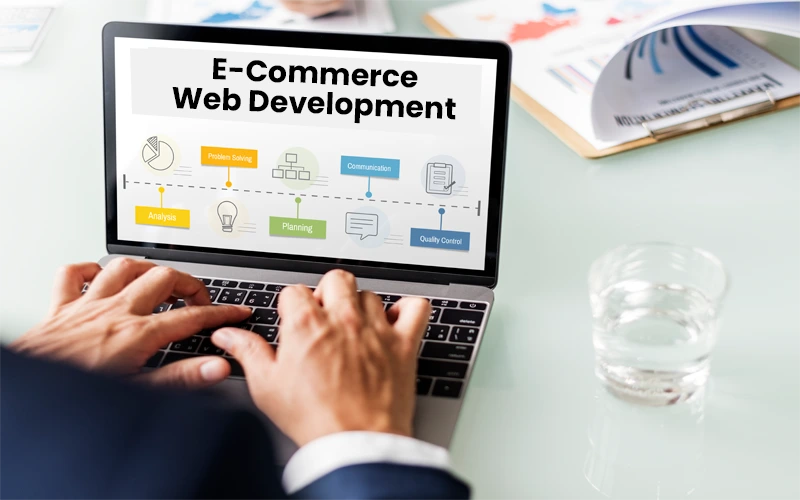
eCommerce Website Development Services | NexivaGen
Build an online store designed to sell, scale and serve your customers. NexivaGen Technologies develops custom eCommerce websites with product catalogues, shopping carts, payments, order management, customer accounts and integrations tailored to your business.
Introduction
Build an Online Store Around Your Business
Selling online requires more than simply putting products on a website.
Your eCommerce platform needs to make it easy for customers to discover products, understand what they are buying, complete purchases and receive the right information after an order.
At NexivaGen Technologies, we develop eCommerce websites around the way your business sells.
Whether you're launching a new online store, moving an existing business online or building a custom commerce platform, we can develop the product catalogue, shopping experience, checkout, customer management and backend functionality required for your business.
Our E-commerce Development Services
eCommerce Solutions We Build
Custom eCommerce Website Development
Develop online stores around your products, customers, business rules and operational requirements.
B2C eCommerce Development
Build customer-facing online stores for selling products directly to consumers.
B2B eCommerce Development
Create commerce platforms for businesses selling to distributors, dealers, retailers or other organizations, including appropriate account and pricing workflows.
Online Store Development
Create professional online stores with product catalogues, categories, search, shopping carts, checkout and customer accounts.
Custom eCommerce Platforms
Build commerce functionality that goes beyond the capabilities of a standard template or off-the-shelf setup.
Multi-Vendor Marketplace Development
Develop platforms where multiple sellers can list products and manage their business activities through a centralized marketplace.
eCommerce Redesign
Modernize an existing online store to improve its design, usability, mobile experience and overall shopping journey.
eCommerce API & Integration
Connect your online store with payment providers, shipping systems, CRM, ERP, inventory and other business services where suitable APIs are available.
What We Can Build
Features for a Complete Online Store
Depending on your business requirements, an eCommerce website can include:
Product Catalogue
- Product categories
- Product variations
- Product attributes
- Multiple images
- Product descriptions
- Pricing
- Stock information
- Related products
Shopping Experience
- Product search
- Filters
- Sorting
- Wishlist
- Shopping cart
- Product comparison where required
- Customer reviews
- Offers and coupons
Checkout
- Customer details
- Address management
- Shipping options
- Payment options
- Order summary
- Order confirmation
Customer Account
- Registration and login
- Profile management
- Saved addresses
- Order history
- Order tracking
- Wishlist
- Account settings
Administration
- Product management
- Category management
- Customer management
- Order management
- Inventory-related management
- Coupon management
- Reports
- Content management
The exact functionality depends on the scope and business model.
Payment Integration
Make Online Checkout Simple
A reliable checkout experience is an important part of eCommerce.
Depending on your requirements and the payment provider selected, we can integrate appropriate payment methods such as:
- Online payments
- Card payments
- UPI
- Net banking
- Wallets
- Cash on delivery
- Payment gateway integrations
Payment options depend on the selected provider, business requirements and supported payment methods.
Order Management
Manage Orders From One Place
An eCommerce system can provide an administrative workflow for:
- New orders
- Order confirmation
- Payment status
- Order processing
- Shipping status
- Order completion
- Cancellation
- Returns
- Refund-related workflows
The workflow can be customized according to the way your business processes orders.
Inventory & Product Management
Keep Your Product Catalogue Organized
Depending on your requirements, the administration system can support:
- Product creation
- Product categories
- Product variants
- Pricing
- Stock information
- SKU management
- Product images
- Product descriptions
- Product status
- Bulk management
- Related products
For larger businesses, inventory systems can also be connected with existing software where suitable integrations are available.
Shipping & Delivery
Connect Your Store With Your Delivery Process
Depending on your business model, eCommerce functionality can support:
- Shipping methods
- Delivery locations
- Shipping charges
- Order status
- Delivery tracking
- Local delivery workflows
- Shipping API integration
The exact shipping functionality depends on your logistics process and chosen shipping provider.
Mobile-Friendly Shopping Experience
Designed for Customers on Every Screen
A large portion of online shopping activity can happen on smartphones, so the shopping experience should work smoothly across different screen sizes.
We focus on:
- Responsive product pages
- Mobile-friendly navigation
- Easy product discovery
- Touch-friendly interactions
- Simple checkout
- Clear calls-to-action
- Fast and usable pages
The goal is to make it easy for customers to browse, evaluate and purchase products regardless of the device they use.
eCommerce SEO Foundation
Build Your Store With Search Visibility in Mind
An online store needs more than products and checkout functionality.
The technical and content structure can be designed to support search visibility through:
- Search-friendly URLs
- Unique page titles
- Meta descriptions
- Product and category page structure
- Proper heading hierarchy
- Product image ALT text
- Internal linking
- XML sitemap
- Canonical URLs
- Structured data where appropriate
- Mobile-friendly pages
- Performance considerations
For eCommerce websites, product and category content should also provide useful information rather than relying only on short manufacturer descriptions.
SEO can improve discoverability, but no development approach can guarantee a particular Google ranking.
eCommerce Integrations
Connect Your Store With Your Business Systems
Depending on your requirements, an online store can integrate with:
- Payment gateways
- Shipping platforms
- CRM systems
- ERP systems
- Inventory systems
- Accounting software
- Email services
- SMS platforms
- WhatsApp services
- Analytics platforms
- Marketing tools
- Third-party APIs
Integrations depend on the available APIs and the capabilities of the systems involved.
B2B & B2C eCommerce
Build for the Way You Sell
B2C eCommerce
Designed for businesses selling directly to consumers.
Typical requirements may include:
- Public product catalogue
- Customer accounts
- Shopping cart
- Online checkout
- Payments
- Offers
- Order tracking
B2B eCommerce
Designed for businesses selling to other businesses.
Depending on requirements, functionality can include:
- Business accounts
- Customer-specific pricing
- Bulk ordering
- Dealer/distributor accounts
- Purchase workflows
- Order management
- Account-based access
The right structure depends on your sales model and customer relationships.
Our E-commerce Development Process
From Product Catalogue to Online Store
01. Understand Your Business
We understand your products, customers, sales process, delivery model and business goals.
02. Plan the Store
We define the product structure, categories, navigation, customer journey and required functionality.
03. Design the Experience
We create the store interface around your brand and customer shopping journey.
04. Develop the Store
The eCommerce platform is developed with the required product, customer, order and administration functionality.
05. Integrate Payments & Services
Payment gateways, shipping systems and other required integrations are connected.
06. Add Products & Content
Products, categories, images and relevant content are added and structured.
07. Test the Shopping Journey
We test product browsing, cart, checkout, payments, customer accounts, orders and important workflows.
08. Launch
After final review, the store is deployed and made available to customers.
09. Improve & Grow
New products, features, integrations and improvements can be introduced as your online business grows.
Why NexivaGen Technologies?
Build Your eCommerce Store With a Technology Partner
Business-Focused Approach
We start with your products, customers and business model.
Custom Development
The store can be designed around your requirements instead of being limited to a generic template.
Conversion-Focused Experience
We focus on making product discovery, evaluation and checkout straightforward.
Mobile-Friendly
Your store can be designed to work across smartphones, tablets and desktop devices.
Integration Ready
Connect your store with payment, shipping, CRM, ERP and other relevant systems.
Scalable Structure
The platform can be planned to accommodate new products, customers and functionality as your business grows.
s. NexivaGen can develop multi-vendor marketplaces where multiple sellers can register, manage products, receive orders, track sales, and operate through a centralized platform.
6. Can you integrate online payment gateways?
Yes. We can integrate suitable payment gateways to support secure online transactions through options such as cards, UPI, net banking, wallets, and other supported payment methods.
7. Can you integrate shipping and delivery services?
Yes. Shipping APIs and logistics integrations can be implemented for shipping calculations, delivery management, order tracking, and related workflows depending on the logistics provider.
8. Can customers create accounts on the eCommerce website?
Yes. Customer registration, login, profile management, order history, saved addresses, wishlist, and other account features can be included.
9. Can you develop an advanced shopping cart and checkout system?
Yes. We can build optimized shopping cart and checkout workflows with product quantities, coupons, shipping charges, taxes, payment selection, address management, and order confirmation.
10. Can you add product variations such as size, color, and weight?
Yes. Product variants can be configured for attributes such as size, color, weight, material, packaging, or other product-specific options.
11. Can you develop an eCommerce admin panel?
Yes. A centralized admin dashboard can be developed to manage products, categories, customers, orders, inventory, payments, coupons, shipping, content, and other store operations.
12. Can an eCommerce website manage inventory?
Yes. Inventory management features can track product stock, variants, availability, low-stock conditions, and inventory updates.
13. Can you integrate WhatsApp with an eCommerce website?
Yes. WhatsApp integration can be added for customer communication, order notifications, inquiries, support, and other approved business workflows.
14. Can you integrate CRM, ERP, accounting, or third-party software?
Yes. APIs and custom integrations can connect an eCommerce website with CRM, ERP, accounting, marketing, logistics, payment, analytics, and other business systems.
15. Will the eCommerce website be mobile-friendly?
Yes. NexivaGen develops responsive eCommerce websites designed to provide a consistent shopping experience across smartphones, tablets, laptops, and desktops.
16. Can you develop an SEO-friendly eCommerce website?
Yes. We can structure eCommerce websites with SEO-friendly URLs, metadata, headings, structured content, technical SEO considerations, schema markup, internal linking, and other search-engine-friendly elements.
17. How much does eCommerce website development cost in India?
The cost depends on the number of products, design requirements, features, integrations, custom functionality, marketplace requirements, payment and shipping systems, and administrative features. NexivaGen can provide a customized quotation after understanding the project scope.
18. How long does it take to develop an eCommerce website?
The development timeline depends on the website's features, design complexity, integrations, number of modules, testing requirements, and client approvals. A simple online store can take significantly less time than a large custom eCommerce platform.
19. Does NexivaGen provide eCommerce website maintenance?
Yes. Post-launch support, bug fixing, performance improvements, security updates, feature enhancements, and ongoing technical maintenance can be provided according to the support requirement.
20. How can I start an eCommerce website development project with NexivaGen?
You can share your business model, products, required features, target customers, preferred integrations, and project objectives with NexivaGen Technologies. Our team can then evaluate the requirements and recommend an appropriate eCommerce solution.
Q&A — eCommerce Website Development Services | NexivaGen
1. How can an eCommerce website help a business increase online sales?
An eCommerce website gives businesses a dedicated digital sales channel where customers can discover products, compare options, place orders, and make payments online. Features such as search, product recommendations, promotions, abandoned-cart recovery, analytics, and optimized checkout can further support sales growth.
2. What features should a modern eCommerce website have?
A modern eCommerce website should typically include product listings, categories, search, filters, product details, shopping cart, checkout, payment integration, customer accounts, order tracking, inventory management, responsive design, security, analytics, and an easy-to-use administration system.
3. How does custom eCommerce development differ from a basic online store?
Custom eCommerce development is designed around the specific business process rather than relying only on standard store functionality. It allows businesses to implement customized pricing, workflows, integrations, dashboards, product structures, customer experiences, and automation.
4. Can NexivaGen build an eCommerce website from scratch?
Yes. NexivaGen Technologies can plan, design, develop, test, deploy, and support a custom eCommerce website from the ground up according to the business requirements.
5. What type of businesses can benefit from eCommerce website development?
Retailers, manufacturers, wholesalers, D2C brands, fashion businesses, electronics companies, food and grocery businesses, beauty brands, furniture companies, handicraft businesses, consumer-product companies, and many other businesses can use eCommerce platforms to sell online.
6. Can an eCommerce website support both retail and wholesale customers?
Yes. A custom eCommerce platform can support separate retail and wholesale purchasing workflows. Businesses can implement bulk pricing, minimum order quantities, customer-specific pricing, wholesale accounts, quotation requests, and other B2B features.
7. Can you develop an eCommerce website for a D2C brand?
Yes. NexivaGen can develop D2C eCommerce websites with branded product experiences, promotional campaigns, customer accounts, payment gateways, shipping integrations, analytics, and conversion-focused checkout experiences.
8. Can an eCommerce website support bulk orders?
Yes. Bulk ordering can be implemented with quantity-based pricing, wholesale packages, minimum order quantities, bulk product selection, quotation requests, and other B2B purchasing features.
9. Can you develop an eCommerce marketplace similar to Amazon or other multi-vendor platforms?
Yes. NexivaGen can develop custom multi-vendor marketplace platforms with seller registration, vendor dashboards, product management, commissions, customer orders, payments, reviews, and administrator controls. The exact functionality depends on the marketplace business model.
10. Can different vendors have separate dashboards?
Yes. A multi-vendor eCommerce platform can provide vendors with dedicated dashboards to manage products, inventory, orders, pricing, customers, sales information, and other permitted activities.
11. Can an eCommerce website have role-based admin access?
Yes. Role-based access can be implemented so that administrators, managers, product teams, order teams, marketing users, and other staff members receive only the permissions relevant to their responsibilities.
12. Can eCommerce websites support coupons and promotional offers?
Yes. Coupon codes, percentage discounts, fixed discounts, product-specific offers, category-based promotions, minimum-order discounts, seasonal campaigns, and other promotional rules can be developed based on the business requirements.
13. Can customers add products to a wishlist?
Yes. Wishlist functionality allows registered customers to save products for future purchases and can be integrated with customer accounts and product availability.
14. Can you add product reviews and ratings?
Yes. Product reviews and ratings can be incorporated to allow customers to provide feedback and help potential buyers evaluate products.
15. Can eCommerce websites include product videos or short shopping reels?
Yes. Product videos, short-form product demonstrations, promotional videos, and shoppable content can be integrated into an eCommerce experience when appropriate for the business model.
16. Can an eCommerce website integrate UPI and Indian payment methods?
Yes. Suitable payment gateway integrations can support commonly used Indian payment methods such as UPI, cards, net banking, and other methods supported by the selected payment provider.
17. Can you integrate GST and tax calculations into an eCommerce platform?
Yes. Tax-related functionality can be incorporated according to the business requirements, product categories, applicable tax rules, billing structure, and accounting workflow.
18. Can an eCommerce website generate invoices automatically?
Yes. Automated invoice generation can be implemented after successful orders, including customer details, products, quantities, taxes, discounts, shipping charges, totals, and other required information.
19. Can an eCommerce website connect with a CRM?
Yes. CRM integration can synchronize relevant customer, inquiry, order, and communication information between the eCommerce platform and CRM system.
20. Can an eCommerce website connect with an ERP system?
Yes. ERP integration can connect the online store with business operations such as inventory, accounting, purchasing, product information, orders, and other enterprise workflows through APIs or suitable integration methods.
21. Can you integrate third-party APIs into an eCommerce website?
Yes. APIs can be integrated for payment gateways, shipping providers, SMS, WhatsApp, email, CRM, ERP, accounting, analytics, inventory, authentication, and other external services.
22. How can an eCommerce website be optimized for Google search?
An eCommerce website can be optimized through technically clean architecture, SEO-friendly URLs, unique product content, optimized titles and descriptions, structured data, internal linking, category optimization, image optimization, crawlability improvements, mobile responsiveness, and strong site performance.
23. Can you develop an eCommerce website with structured data and product schema?
Yes. Relevant structured data such as product, offer, review, organization, breadcrumb, and other applicable schema types can be implemented according to the website's content and functionality.
24. How important is website speed for an eCommerce store?
Website speed is important because slow pages can negatively affect user experience, engagement, and conversions. eCommerce performance can be improved through optimized images, efficient code, caching, database optimization, appropriate hosting, and other performance techniques.
25. Can an eCommerce website handle a large product catalog?
Yes. The architecture can be planned to support large product catalogs using efficient database structures, search and filtering, optimized queries, caching, image optimization, and scalable infrastructure where required.
26. Can an eCommerce platform scale as the business grows?
Yes. A properly planned eCommerce architecture can be designed to accommodate increasing products, customers, orders, traffic, integrations, and business operations. The appropriate scaling strategy depends on the application's architecture and infrastructure.
27. Can NexivaGen migrate an existing online store to a new eCommerce platform?
Yes. NexivaGen can assist with eCommerce migration, including products, categories, customers, orders, content, selected integrations, and other relevant data, subject to the source platform and migration requirements.
28. Can you redesign an existing eCommerce website without changing the entire system?
Yes. Depending on the existing technology and architecture, NexivaGen can redesign the user interface and improve the shopping experience while retaining suitable backend functionality. A technical assessment is recommended before deciding between redesign and redevelopment.
29. How much does custom eCommerce website development cost?
Custom eCommerce development pricing varies according to design complexity, number of modules, product catalog size, payment and shipping integrations, custom workflows, marketplace functionality, ERP/CRM integration, mobile applications, and other requirements. NexivaGen provides project-specific estimates rather than using a single fixed price for every business.
30. How long does it take to build a custom eCommerce website?
The timeline depends on project scope, design approval, number of features, integrations, data migration, testing, content availability, and feedback cycles. A clearly defined scope generally makes planning and delivery more predictable.
31. Why choose NexivaGen Technologies for eCommerce website development?
NexivaGen Technologies focuses on building customized digital commerce solutions around the client's business model rather than treating every online store as the same project. Our services can cover UI/UX design, eCommerce development, payment integration, APIs, admin dashboards, third-party integrations, deployment, and ongoing technical support.
32. How do I get started with NexivaGen for an eCommerce project?
Start by sharing your business type, products or services, target market, required features, preferred payment and shipping options, integrations, expected customer volume, and any reference websites you like. NexivaGen Technologies can review the requirements and propose an appropriate eCommerce architecture, feature set, development approach, timeline, and commercial estimate.
Ready to Take Your Business Online?
Build an eCommerce website that makes it easier for customers to discover your products, place orders and connect with your business.
Build Your Online Store
Let's Discuss Your Requirement
Tell us about your requirement and our team will get in touch with you shortly.
Let’s Build the Future Together
Partner with us to design, build, and scale intelligent digital solutions.