


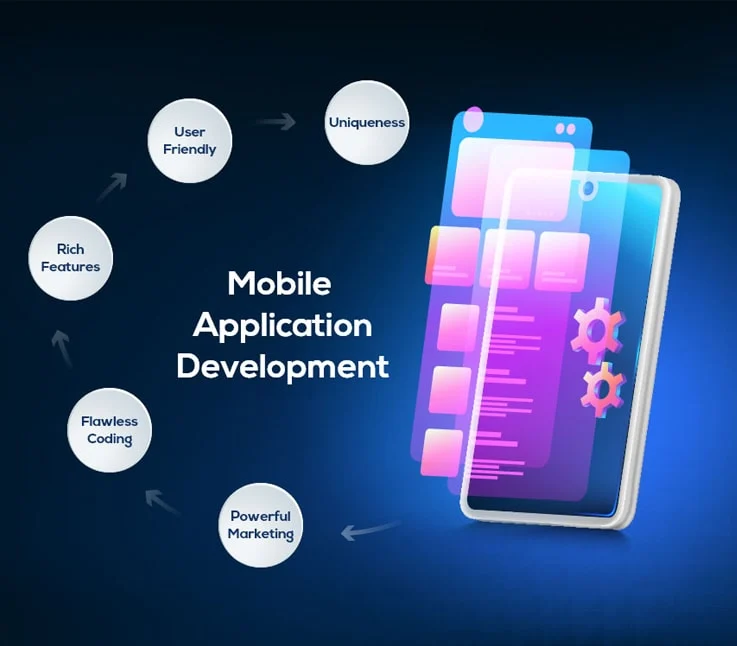
Mobile App Development Services | NexivaGen Technologies
Build mobile experiences that keep your customers and business connected. NexivaGen Technologies develops custom Android, iOS and cross-platform mobile applications designed around your users, business processes and long-term goals.
Introduction
Mobile Apps Built Around Your Business
A mobile application should do more than simply put your business on a smartphone. It should make an important task easier, provide a better customer experience or create a more efficient way for your team to work.
At NexivaGen Technologies, we develop mobile applications around the purpose of your product and the people who will use it.
Whether you need a customer-facing app, internal business application, booking platform, e-commerce app or a completely custom mobile product, we can help transform the requirement into a structured mobile experience.
Our Mobile App Development Services
Mobile Applications We Develop
Android App Development
Build applications for Android devices with interfaces and functionality designed around your target users and business requirements.
iOS App Development
Create mobile applications for Apple's ecosystem with experiences designed specifically for iPhone and iPad users where required.
Cross-Platform App Development
Develop applications that can support multiple mobile platforms through a shared development approach, depending on project requirements.
Business Mobile Applications
Create internal or customer-facing mobile applications that support business processes, communication, productivity and customer services.
E-commerce Mobile Apps
Build mobile shopping experiences with product browsing, customer accounts, carts, orders, payments and other required commerce functionality.
Booking & Appointment Apps
Develop applications for appointments, reservations, service bookings, schedules and customer management.
On-Demand Service Apps
Create platforms that connect customers with service providers and manage requests, assignments, status updates and related workflows.
Customer Apps
Give customers a dedicated mobile experience for accessing services, managing accounts, tracking requests or interacting with your business.
Employee & Field-Service Apps
Build mobile applications that help employees or field teams manage tasks, assignments, forms, updates and business activities while on the move.
What Can We Build?
Mobile Apps for Different Business Requirements
Depending on your project, we can develop:
- Customer applications
- Business applications
- E-commerce apps
- Booking applications
- Service marketplace apps
- On-demand service apps
- Education apps
- Real estate apps
- Restaurant applications
- Employee applications
- Field-service apps
- Membership applications
- Communication apps
- Delivery-related applications
- Business management apps
The final features and architecture depend on the application's purpose and requirements.
Mobile App Features
Features We Can Build Into Your App
Depending on the project scope, mobile applications can include:
- User registration and login
- Social login
- User profiles
- Role-based access
- Push notifications
- Search and filters
- Location services
- Google Maps integration
- Booking and scheduling
- Shopping cart
- Online payments
- Order management
- Chat and messaging
- File uploads
- Document access
- Reviews and ratings
- Wishlist
- Coupons and promotions
- Subscription functionality
- In-app notifications
- Analytics
- API integrations
- Admin dashboard
These are development capabilities, not features that every app automatically includes.
Native vs Cross-Platform
Choosing the Right Mobile Development Approach
Every application has different requirements.
Native Development
Native applications are developed specifically for a mobile operating system such as Android or iOS.
This approach can be appropriate when a project requires platform-specific capabilities or highly specialized performance.
Cross-Platform Development
Cross-platform development can allow an application to support multiple platforms while sharing a significant portion of the codebase.
This can be useful when businesses want to launch across platforms with a more unified development approach.
How We Choose
We consider:
- Target users
- Platforms required
- App functionality
- Device capabilities
- Performance requirements
- Development timeline
- Maintenance requirements
- Budget
- Future scalability
The technology should follow the product requirements—not the other way around.
UI/UX for Mobile Apps
Designed for Real Mobile Users
Mobile interfaces need to work differently from desktop websites.
Our mobile UI/UX approach focuses on:
- Simple navigation
- Clear information hierarchy
- Touch-friendly interactions
- Easy-to-complete tasks
- Responsive layouts
- Consistent components
- Clear calls-to-action
- Appropriate use of mobile device capabilities
We can take the app from:
User Flow → Wireframe → UI Design → Prototype → Development
Mobile App Development Process
From App Idea to Launch
01. Understand the Idea
We discuss your business model, target users, app objectives and required functionality.
02. Define Requirements
We identify features, user roles, workflows, integrations and platform requirements.
03. Plan the User Experience
We map important user journeys and determine how users will navigate through the application.
04. Design the App
Our UI/UX team creates the interface, screens, components and prototypes.
05. Develop the Application
The development team builds the mobile application according to the approved design and requirements.
06. Integrate APIs & Services
Required APIs, payment systems, maps, notifications and other services are integrated.
07. Test
We test functionality, navigation, device compatibility, permissions, integrations and important user journeys.
08. Deployment
The application is prepared for the relevant app stores or distribution environment.
09. Support & Improvements
After launch, the application can be maintained, improved and expanded as your users and business requirements evolve.
Backend & API Integration
Connect Your Mobile App to Your Business Systems
A mobile application often needs a backend to manage users, data, transactions and business processes.
We can connect mobile applications with:
- REST APIs
- Custom backend systems
- Laravel applications
- Node.js applications
- CRM systems
- ERP systems
- Payment gateways
- Google Maps
- Notification services
- Communication APIs
- Cloud services
- Third-party platforms
This allows your mobile application to work as part of your wider digital ecosystem.
Industries We Serve
Mobile Apps for Different Industries
E-commerce & Retail
Shopping, product discovery, orders, payments and customer engagement.
Education
Learning applications, student platforms, course applications and educational services.
Real Estate
Property discovery, enquiries, agent communication and customer services.
Healthcare
Appointment-related applications, service access and appropriate healthcare workflows.
Hospitality
Restaurant, hotel, booking and customer experience applications.
Transportation & Services
Booking, tracking, service requests and customer-provider platforms.
Professional Services
Customer applications, appointment systems, service access and business communication.
Why NexivaGen Technologies?
A Mobile App Development Partner for Your Business
Business-Focused
We begin by understanding what the app needs to accomplish for your business and users.
Custom Development
We build functionality around your requirements rather than forcing your idea into a generic template.
User-Centered Design
We focus on making the app clear and easy to use.
Scalable Architecture
The application can be planned with future users, features and integrations in mind.
API & Integration Capability
Mobile apps can be connected with your existing backend and relevant third-party services.
End-to-End Capability
UI/UX design, mobile development, backend integration, testing and deployment can be handled as part of the project.
Mobile App Security
Built With Security in Mind
Mobile applications may handle user accounts, personal information, transactions and business data.
Depending on the project, we consider:
- Secure authentication
- Authorization
- Role-based access
- Secure API communication
- Input validation
- Data protection
- Session management
- Secure storage considerations
- Error handling
- Access controls
Applications handling sensitive or regulated information may require additional security and compliance assessment.
App Store & Launch Support
From Development to Launch
A mobile application isn't finished when development ends.
Depending on the project, we can help prepare the application for distribution through relevant app stores and environments.
This can include:
- Production builds
- App configuration
- App icons and assets
- Screenshots
- Store listing content
- Testing builds
- Deployment preparation
- Version updates
App-store approval is ultimately subject to the respective platform's policies and review process.
FAQ — Mobile App Development Services | NexivaGen Technologies
1. What is mobile app development?
Mobile app development is the process of designing, developing, testing, and deploying applications for smartphones and tablets. Mobile apps can be created for Android, iOS, or multiple platforms depending on business requirements.
2. What mobile app development services does NexivaGen Technologies provide?
NexivaGen Technologies provides custom mobile app development services for startups, businesses, SMEs, and enterprises. Services can include Android app development, iOS app development, cross-platform app development, UI/UX design, API integration, backend development, app testing, deployment, and ongoing maintenance.
3. Do you develop custom mobile applications?
Yes. We develop custom mobile applications based on business requirements, target users, industry needs, workflows, integrations, and future scalability requirements.
4. Do you develop Android applications?
Yes. NexivaGen Technologies develops custom Android applications for businesses, startups, organizations, and consumer-facing products.
5. Do you develop iOS applications?
Yes. We can develop custom iOS applications for businesses that want to provide digital services and experiences to Apple device users.
6. Do you develop cross-platform mobile applications?
Yes. Cross-platform development can be considered when a business wants to deliver applications across Android and iOS while maintaining a shared development approach.
7. What types of mobile apps can you develop?
We can develop e-commerce apps, booking apps, service apps, business apps, education apps, healthcare apps, real estate apps, logistics apps, marketplace apps, social applications, customer portals, employee apps, on-demand apps, and other customized mobile applications.
8. Can you develop mobile apps with payment gateway integration?
Yes. Mobile applications can integrate suitable payment gateways for purchases, bookings, subscriptions, invoices, memberships, and other transactions.
9. Can mobile apps integrate with existing websites and software?
Yes. Mobile applications can connect with websites, web applications, CRM systems, ERP platforms, databases, APIs, payment systems, and other business software.
10. Can you develop apps with user registration and login?
Yes. Mobile applications can include registration, login, OTP verification, email authentication, social login, password recovery, profile management, and other authentication features.
11. Can mobile applications include push notifications?
Yes. Push notifications can be implemented for order updates, bookings, reminders, promotions, messages, alerts, status changes, and other relevant user communications.
12. Can you develop mobile apps with an admin panel?
Yes. Mobile applications can be connected to a web-based admin panel where administrators can manage users, products, orders, bookings, content, notifications, reports, settings, and other application data.
13. Are mobile apps developed with secure architecture?
Security can be incorporated through secure authentication, authorization, encrypted communication, secure APIs, appropriate data protection, input validation, access controls, and other application security practices.
14. How much does mobile app development cost in India?
Mobile app development costs depend on the platform, number of features, UI/UX complexity, backend requirements, integrations, user roles, security requirements, testing, and maintenance. A project-specific estimate can be provided after evaluating the requirements.
15. How long does it take to develop a mobile app?
The timeline depends on the app's functionality, number of screens, platform requirements, backend development, integrations, testing, revisions, and deployment requirements. A simple application will generally take less time than a feature-rich business platform.
16. Can you redesign an existing mobile application?
Yes. Existing applications can be redesigned to improve UI/UX, usability, performance, navigation, visual consistency, accessibility, and overall user experience.
17. Can you maintain and support mobile applications after launch?
Yes. Post-launch support can include bug fixing, performance improvements, security updates, OS compatibility updates, API updates, feature enhancements, monitoring, and technical maintenance.
18. Can mobile apps integrate with AI and Machine Learning?
Yes. AI/ML capabilities can be integrated into mobile applications for chatbots, recommendations, intelligent search, personalization, image analysis, predictive functionality, document processing, automation, and other use cases.
19. Can mobile apps be connected to a web application?
Yes. Mobile applications can communicate with web applications through APIs and shared backend services, allowing users and administrators to work within a connected digital ecosystem.
20. How can I start a mobile app development project with NexivaGen Technologies?
Share your app idea, target users, required features, preferred platforms, design requirements, integrations, and business objectives. NexivaGen Technologies can evaluate the requirements and recommend an appropriate development strategy.
Q&A — Mobile App Development Services
Q1. Why should a business invest in mobile app development?
A mobile application can provide customers with convenient access to products, services, bookings, support, accounts, payments, and other business services. A dedicated app can also enable personalized experiences, push notifications, customer engagement, and direct communication.
Q2. What is the difference between Android and iOS app development?
Android and iOS are different mobile operating systems with different development ecosystems, device environments, guidelines, and distribution processes. Businesses can choose one platform or develop for both based on their target audience, market, budget, and business objectives.
Q3. Should my business develop an Android app, iOS app, or both?
The right choice depends on your target audience, geographic market, customer demographics, business model, budget, and growth strategy. If your customers use both platforms, developing for Android and iOS can provide broader coverage.
Q4. What is cross-platform mobile app development?
Cross-platform development allows an application to be developed for multiple operating systems using a shared development approach. It can help businesses reach Android and iOS users while potentially reducing duplicated development effort.
Q5. What types of businesses need mobile applications?
Mobile applications can benefit businesses in e-commerce, healthcare, education, real estate, hospitality, logistics, travel, finance, retail, professional services, entertainment, food delivery, transportation, and many other industries.
Q6. Can you develop a mobile app for a startup?
Yes. Startups can develop an MVP or initial version with essential features and expand the application as the business validates its product, gains users, and receives feedback.
Q7. What is an MVP mobile application?
A Minimum Viable Product, or MVP, is an initial version of a mobile application containing the essential functionality needed to launch, test the business idea, and gather real user feedback before investing in additional features.
Q8. What features can a custom mobile application include?
Depending on the requirements, a mobile application can include user registration, login, profiles, search, filters, payments, bookings, maps, GPS, chat, push notifications, subscriptions, reviews, ratings, order tracking, dashboards, media, APIs, and administrative functionality.
Q9. Can you develop e-commerce mobile applications?
Yes. E-commerce apps can include product catalogs, categories, search, filters, product details, wishlist, cart, checkout, payment gateways, coupons, order tracking, customer accounts, notifications, and administrative management.
Q10. Can you develop mobile booking applications?
Yes. Booking apps can be developed for hotels, transportation, healthcare, appointments, services, events, travel, and other industries. Features can include availability, scheduling, booking confirmation, payments, cancellations, reminders, and notifications.
Q11. Can you develop on-demand mobile applications?
Yes. On-demand applications can connect customers with service providers, delivery personnel, professionals, technicians, drivers, or other service partners. Depending on the business model, the app can include customer, provider, and administrator interfaces.
Q12. Can mobile apps use GPS and location-based services?
Yes. Depending on the use case and permissions, mobile applications can use location services for maps, navigation, delivery tracking, nearby services, driver tracking, location-based searches, and other functionality.
Q13. Can you integrate Google Maps or mapping services into a mobile app?
Yes. Mapping and location APIs can be integrated for features such as maps, location selection, route information, nearby locations, delivery tracking, and other location-based functionality.
Q14. Can mobile applications integrate with CRM and ERP systems?
Yes. APIs can connect mobile applications with CRM and ERP systems to provide users with relevant customer, sales, inventory, service, operational, and other business information.
Q15. Can mobile apps integrate with websites and web portals?
Yes. A mobile app can use APIs to communicate with a website, web application, or web portal. This allows different platforms to use shared business logic, databases, user accounts, and services.
Q16. Can mobile apps support multiple user roles?
Yes. Applications can provide different interfaces and permissions for customers, employees, vendors, partners, agents, administrators, drivers, service providers, and other user types.
Q17. Can mobile apps support subscription-based businesses?
Yes. Subscription applications can include plans, recurring payments, account management, subscription upgrades or cancellations, invoices, notifications, and administrative controls, subject to the applicable app-store and payment requirements.
Q18. How important is mobile app UI/UX design?
UI/UX is critical because mobile users interact directly with the application's interface. Good mobile UX can simplify navigation, reduce friction, make tasks easier, improve engagement, and create a more consistent brand experience.
Q19. What is the mobile app development process?
A typical process includes requirements analysis, product planning, UI/UX design, technical architecture, frontend and backend development, API integration, testing, security checks, deployment, monitoring, and ongoing improvements.
Q20. Can you develop the backend and APIs for a mobile app?
Yes. Mobile applications generally require backend services for user management, databases, authentication, business logic, notifications, payments, APIs, and other server-side functionality. These backend components can be developed according to the application requirements.
Q21. How do you test a mobile application?
Mobile applications can be tested for functionality, usability, compatibility, performance, security, API behavior, device responsiveness, navigation, forms, notifications, payments, and other relevant workflows before release.
Q22. Can mobile applications work across different screen sizes and devices?
Yes. Responsive and adaptive design techniques can be used to accommodate different screen sizes and device specifications. Device compatibility should be considered during both design and testing.
Q23. Can an existing mobile app be upgraded to add new features?
Yes. Existing applications can be enhanced with new features, UI/UX improvements, integrations, performance optimization, security updates, and compatibility improvements based on current business requirements.
Q24. Can a mobile application be migrated from one technology to another?
Depending on the existing application's architecture, a migration or redevelopment strategy can be planned. The existing codebase, database, APIs, features, integrations, and business-critical functionality should be evaluated before choosing the appropriate approach.
Q25. How can mobile apps help businesses increase customer engagement?
Mobile apps can provide personalized experiences, push notifications, loyalty features, convenient account access, faster transactions, real-time updates, exclusive offers, and direct communication, helping businesses maintain regular customer interaction.
Q26. Can mobile apps support AI-powered features?
Yes. AI can be integrated into mobile applications for intelligent assistants, chatbots, recommendations, personalized content, image recognition, voice-based functionality, predictive analytics, document processing, and other business use cases.
Q27. How much does custom mobile app development cost in India?
The cost depends on the number of platforms, features, screens, backend requirements, integrations, UI/UX complexity, user roles, security, testing, deployment, and ongoing maintenance. A detailed estimate requires an understanding of the complete app scope.
Q28. How long does it take to build a custom mobile app?
Development time depends on the app's complexity, number of platforms, features, backend architecture, integrations, testing requirements, and approval process. An MVP generally requires less time than a feature-rich enterprise application.
Q29. How do I choose the right mobile app development company?
Consider the company's experience, technical capabilities, UI/UX expertise, development process, security approach, testing practices, integration capabilities, communication, scalability planning, and post-launch support.
Q30. Why choose NexivaGen Technologies for mobile app development?
NexivaGen Technologies focuses on custom mobile app development aligned with business objectives and user requirements. Our approach considers UI/UX, functionality, backend architecture, integrations, security, scalability, performance, testing, and long-term support to build practical mobile solutions.
Q31. Can NexivaGen Technologies provide end-to-end mobile app development?
Yes. Depending on the project, end-to-end services can cover business analysis, UI/UX design, mobile app development, backend development, API integration, database development, testing, deployment, app-store preparation, maintenance, and future feature development.
Q32. How can I start developing a mobile application with NexivaGen Technologies?
Start by sharing your app concept, target audience, required features, preferred platforms, business model, integrations, design preferences, and expected outcome. NexivaGen Technologies can analyze your requirements and prepare a suitable mobile app development strategy and proposal.
Have an App Idea?
Let's turn your idea into a mobile product that your customers and team can actually use.
Start Your Mobile App Project
Let's Discuss Your Requirement
Tell us about your requirement and our team will get in touch with you shortly.
Let’s Build the Future Together
Partner with us to design, build, and scale intelligent digital solutions.